A dash cam is the only device most people own that writes to its memory card continuously, every day, forever. It fills the card, then goes back to the beginning and writes over what is there. A card sold for holiday photographs is asked to do that perhaps a few hundred times in its life. A card in a dash cam does it every week.
That is the entire reason this category exists, and it is why the card that came in the box with your camera is usually the first thing to fail. What it is not is a reason to trust the headline number on the packet.
The endurance figures are not comparable
Every card in this category advertises a number of hours. Those numbers are the least useful thing on the listing, because no two brands measure them the same way and only one of the four here says how it measured at all.
| Card | Capacity | Published endurance | States what the hours measure? |
|---|---|---|---|
| SanDisk High Endurance | 128 GB | Up to 10,000 hours | Yes — Full HD only, fewer at 4K |
| Integral High Endurance | 128 GB | Up to 24,000 hours | No |
| Samsung PRO Endurance | 128 GB | Up to 140,000 hours | No |
| SanDisk High Endurance | 256 GB | Up to 20,000 hours | Yes — Full HD only, fewer at 4K |
Three 128 GB endurance cards, and the claims run from 10,000 hours to 140,000. A fourteen-fold difference between parts of the same capacity, sold for the same job, is not a difference in flash memory. It is a difference in what each maker chose to count.
What a speed class actually guarantees
The marks on the card — C10, U1, U3, V10, V30 — are the part of the specification that is defined by somebody other than the seller. The SD Association, which sets them, describes the problem they exist to solve: transfer speed on flash memory varies, and video needs a constant writing speed, so each class assures a minimum sequential performance under conditions the standard defines.
In practical terms that is the difference between a card that keeps up with a 4K stream and one that drops frames. V30 is the class dash cam makers specify against, and it is what you should look for on the packet.
| Card | Class marks published | Read / write published |
|---|---|---|
| Integral High Endurance 128 GB | V30, U3, A2 | 100 / 50 MB/s |
| SanDisk High Endurance 128 GB | C10, U3, V30 | Not published |
| SanDisk High Endurance 256 GB | V30, C10, U3 | Not published |
| Samsung PRO Endurance 128 GB | Not published in the listing | 100 / 40 MB/s |
| SanDisk Ultra 128 GB (not a dash cam card) | V10, U1, C10, A5 | Up to 195 MB/s read |
The last row is there as a warning. The SanDisk Ultra sits beside the High Endurance card at a nearly identical price, looks like it in a search result, and advertises a much bigger number — 195 MB/s read. It is a V10, U1 card. It is not built for continuous write, it is not sold for it, and the giant read figure describes the direction of travel a dash cam never uses.
How we ranked these
- Does the listing publish a speed class mark, and is it V30?
- Does it publish read AND write speed? Write is the number a recording camera is limited by.
- Does it say what its endurance hours measure, or is the figure bare?
- Does it publish an operating temperature range, for a part that lives on a windshield?
- Does it publish a warranty term?
Nothing on this page is a test result. We have not worn out a card and we do not pretend to have. This is a ranking of what each maker is willing to put in writing, which on a part with no visible failure mode until the day you need the footage is the only honest basis available.
| Spec | Integral | SanDisk | Samsung | SanDisk |
|---|---|---|---|---|
| Capacity | 128 GB | 128 GB | 128 GB | 256 GB |
| Published endurance | Up to 24,000 hours continuous recording | Up to 10,000 hours | Up to 140,000 hours (stated as over 16 years) | Up to 20,000 hours |
| What the hours measure | Not published | Full HD only — stated to be fewer at 4K | Not published | Full HD only — stated to be fewer at 4K |
| Speed class marks | V30, U3, A2 | C10, U3, V30 | Not published | V30, C10, U3 |
| Published read/write | Up to 100 / 50 MB/s | Not published | Up to 100 / 40 MB/s | Not published |
| Operating temperature | -25°C to 85°C | Not published | -25°C to 85°C | Not published |
| Warranty | Not published | Not published | Up to 5 years | Not published |
| Adapter included | Not published | Yes, full-size SD | Yes, full-size SD | Yes, full-size SD |
Quick picks
| # | Product | Best for | Price |
|---|---|---|---|
| 1 | 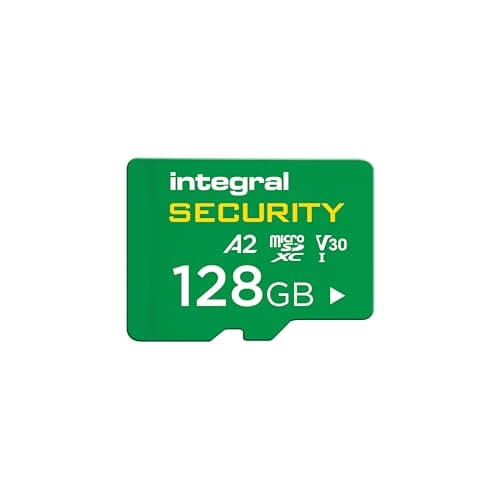 Integral 128GB High Endurance microSD Card for CCTV and Dash CamThe only card here that publishes endurance hours, a speed class, read AND write speeds, a temperature range and a power-loss protection feature — the full set, on a card priced near the cheapest. | The most complete specification sheet in the category | $47.95 · View on Amazon #ad Price as of October 25, 2026. How we’re funded |
| 2 | 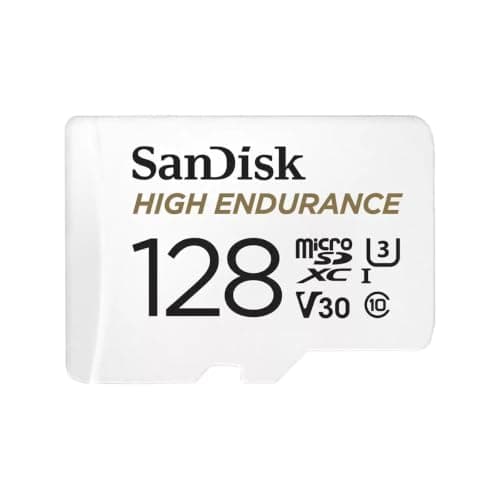 SanDisk 128GB High Endurance Video microSDXC Card with AdapterThe card most dash cam makers name in their own manuals, and the only one here that tells you its endurance figure is measured on Full HD rather than on the 4K the camera actually shoots. | The default card for most dash cams | $36.99 · View on Amazon #ad Price as of October 25, 2026. How we’re funded |
| 3 | 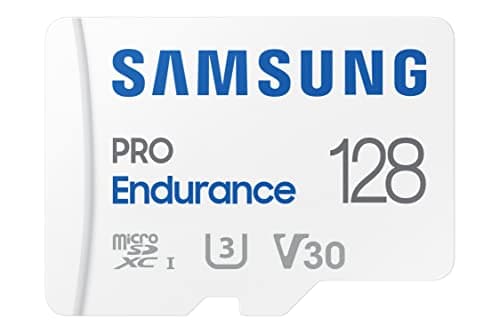 Samsung PRO Endurance 128GB microSDXC Memory Card with AdapterPublishes 140,000 hours against SanDisk's 10,000 at the same capacity, which tells you something important — not about the cards, but about how unregulated this number is. | The longest published endurance claim, by a factor of fourteen | $76.99 · View on Amazon #ad Price as of October 25, 2026. How we’re funded |
| 4 | 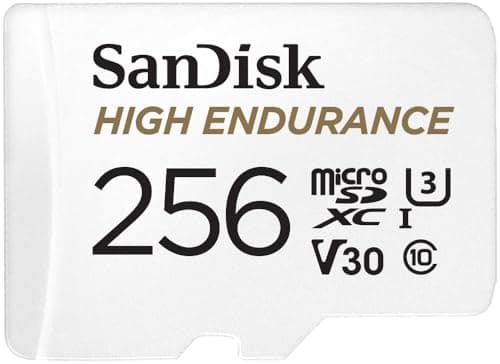 SanDisk 256GB High Endurance microSD Card with AdapterThe same card as the 128 GB version with twice the space and twice the published hours, which is the right buy for a three-camera setup writing three files at once. | 3-channel cameras and anyone who hates overwriting footage | $69.99 · View on Amazon #ad Price as of October 25, 2026. How we’re funded |
#1 · The most complete specification sheet in the category
Integral 128GB High Endurance microSD Card for CCTV and Dash Cam
Integral
The only card here that publishes endurance hours, a speed class, read AND write speeds, a temperature range and a power-loss protection feature — the full set, on a card priced near the cheapest.
Count the published figures and this listing wins: hours, three class marks, both transfer speeds and a temperature range. Nothing else here publishes all five.
The specification the others do not mention at all is sudden power-off protection. A dash cam loses power the instant the ignition cuts, mid-write, several times a day. A card that names that failure mode is at least designing for the way the device is actually used.
The 50 MB/s write figure is the highest published here, and write speed — not read — is what a camera is limited by while recording.
What works
- Publishes the fullest specification set of any card on this page
- Highest published write speed here at 50 MB/s
- Names sudden power-off protection, which nothing else here mentions
- V30, U3 and A2 marks all stated
What does not
- Does not state the resolution behind its 24,000 hour figure
- No warranty term published
- No SD adapter mentioned in the listing, unlike both SanDisk cards and the Samsung
- Sold by the manufacturer rather than through Amazon, so delivery terms can differ
Skip this if
Skip it if you want the card your camera's manual names. Dash cam manuals overwhelmingly cite SanDisk and Samsung, and while that is brand inertia rather than engineering, it is the thing support will ask about when a card fails.
Where these numbers came from
We have not handled this product. Here is what we did instead.
#2 · The default card for most dash cams
SanDisk 128GB High Endurance Video microSDXC Card with Adapter
SanDisk
The card most dash cam makers name in their own manuals, and the only one here that tells you its endurance figure is measured on Full HD rather than on the 4K the camera actually shoots.
This is the card the category is built around, and the endurance claim is the reason: 10,000 hours of continuous write on a part that costs less than a tank of fuel.
Read the footnote though, because it changes the number. Those 10,000 hours are Full HD. If you bought a 4K camera — and most of this site's dash cam picks are 4K — the real figure is lower and SanDisk does not say by how much.
The three class marks matter more than the hours for whether the camera works at all. V30 is the video class a 4K camera is normally specified against, and this card carries it where some more expensive endurance cards do not publish a class at all.
What works
- Publishes three speed class marks, including V30
- Discloses that its endurance figure is measured on Full HD
- Widely named in dash cam manuals, so compatibility is rarely the question
- Full-size SD adapter in the box for pulling clips on a laptop
What does not
- No published read or write speed anywhere in the listing
- No operating temperature range published, only the words temperature proof
- No warranty term published on the listing
- The headline hours are a Full HD figure, so 4K owners are buying an unstated number
Skip this if
Skip it if your camera is one of the 3-channel models that fills a card three times as fast. At that write rate the 256 GB version of the same card is the more honest purchase, and the price gap is smaller than the capacity gap.
Where these numbers came from
We have not handled this product. Here is what we did instead.
#3 · The longest published endurance claim, by a factor of fourteen
Samsung PRO Endurance 128GB microSDXC Memory Card with Adapter
Samsung
Publishes 140,000 hours against SanDisk's 10,000 at the same capacity, which tells you something important — not about the cards, but about how unregulated this number is.
The 140,000 hour claim is the largest number in this category by a wide margin, and the honest way to read it is as a claim rather than a measurement — because Samsung does not publish what resolution or duty cycle produced it.
What it does publish, and SanDisk does not, is the pair of numbers you can actually check against a camera: 100 MB/s read and 40 MB/s write, plus an operating range of -25°C to 85°C. For a card that sits on a windshield in July, the temperature range is not decoration.
The gap in its listing is the speed class. There are no class marks in the bullet text, which for a 4K dash cam buyer is the one line you would want to see.
What works
- Publishes read and write speeds, which most endurance cards do not
- Publishes an operating temperature range rather than the word proof
- States a warranty term, up to five years
- Highest published endurance figure of any card here
What does not
- No speed class mark published in the listing bullets
- Does not state the resolution its 140,000 hour figure was measured at
- Roughly twice the price of the SanDisk card at the same capacity
- The endurance claim cannot be compared with any rival's, because no two are measured the same way
Skip this if
Skip it if you are buying on the endurance number alone. Paying double for a claim measured by an undisclosed method is not a specification decision, and the read and write speeds are the part of this listing actually worth the money.
Where these numbers came from
We have not handled this product. Here is what we did instead.
#4 · 3-channel cameras and anyone who hates overwriting footage
SanDisk 256GB High Endurance microSD Card with Adapter
SanDisk
The same card as the 128 GB version with twice the space and twice the published hours, which is the right buy for a three-camera setup writing three files at once.
Doubling capacity doubles the published hours, which is the clue to how these figures are built: they are a function of how long it takes to fill and rewrite the card, not a measurement of the silicon's fatigue life.
That is exactly why capacity matters on a 3-channel camera. Three simultaneous streams fill a card three times as fast, so the loop overwrites three times as often, and every overwrite is a write cycle.
Check your camera's stated maximum card size before buying this. Plenty of cameras stop at 128 GB, and the listing cannot know which one you own.
What works
- Twice the capacity and twice the published hours of the 128 GB card
- V30 class mark stated in the listing title
- Same Full HD disclosure as the smaller card, rather than a bare number
- Full-size SD adapter included
What does not
- Many dash cams cap out at 128 GB and will not read it
- No read or write speed published
- No temperature range or warranty term published
- Costs nearly twice the 128 GB card for capacity a single-channel camera rarely needs
Skip this if
Skip it if your camera's manual caps the card at 128 GB. A larger card in a camera that cannot address it is not a bigger buffer — in most cameras it simply is not recognized.
Where these numbers came from
We have not handled this product. Here is what we did instead.
Buy the capacity your camera supports, not the biggest
Camera makers publish a maximum supported card size and it varies more than you would expect. Among the cameras ranked on this site, one states support up to 512 GB and ships no card at all, another states up to 256 GB and includes a 32 GB card, and several ship 64 or 128 GB cards without publishing a ceiling at all.
A card larger than the camera can address is not a larger buffer. In most cameras it simply is not recognized, and you find that out in a parking lot with a phone in your hand.
What nobody in this category publishes
- A shared endurance test. There is no published standard behind the hours figures, which is why they differ by a factor of fourteen.
- Terabytes written, the measure used for solid-state drives, which would make these cards directly comparable.
- The numeric minimum behind each speed class mark. The SD Association publishes those as a graphic rather than as text, and we are not going to transcribe figures we could not read as text.
- Any statement of how a card degrades. Cards in this class do not announce failure — the footage is simply not there.
- Operating temperature on either SanDisk listing, which says temperature proof and leaves it there.
Format the card in the camera, not the computer
This is the one piece of handling advice worth the space. Dash cams write a specific file structure and most of them include a format function for exactly this reason. A card formatted by a laptop is the single most common cause of a camera that records for a week and then stops.
Reformatting every month or two is the other habit worth having. It is thirty seconds in the camera menu, and it clears the fragmented remains of thousands of loop files.
Sources
Everything on this page traces back to one of these. Where a figure could not be sourced, the page says so rather than filling the gap.
- SD Association, Speed Class Standards for Video Recording — on why variable flash transfer speed is difficult for video and what a speed class assures
- SanDisk 128GB High Endurance microSDXC, C10 U3 V30, up to 10,000 hours stated as Full HD video only — retailer listing, Amazon.com (retrieved 2026-09-27)
- SanDisk 256GB High Endurance microSD, V30, up to 20,000 hours stated as Full HD video only — retailer listing, Amazon.com (retrieved 2026-09-27)
- Samsung PRO Endurance 128GB microSDXC, up to 140,000 hours, 100/40 MB/s, -25°C to 85°C, up to 5-year warranty — retailer listing, Amazon.com (retrieved 2026-09-27)
- Integral 128GB High Endurance microSD, V30 U3 A2, 100/50 MB/s, up to 24,000 hours continuous recording — retailer listing, Amazon.com (retrieved 2026-09-27)
- SanDisk 128GB Ultra microSD, V10 U1 C10 A5, up to 195 MB/s read — the non-endurance card sold alongside, retailer listing, Amazon.com (retrieved 2026-09-27)