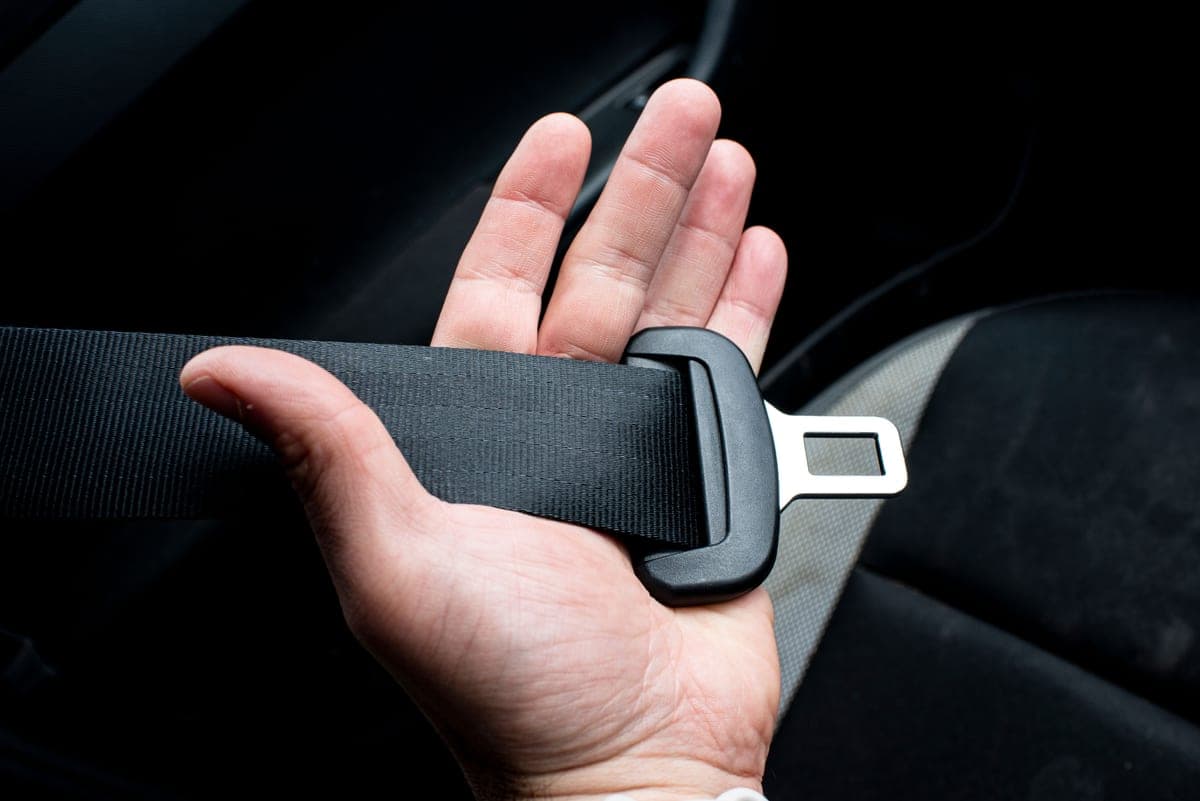
This question gets asked constantly and answered almost nowhere, which is why it is on this site. The honest answer has three parts: what is regulated, what is not, and the principle that fills the gap.
What is regulated: nothing, directly
There is no Federal Motor Vehicle Safety Standard that applies to a seat gap filler. In its published interpretation letters, NHTSA has stated that products of this general kind — aftermarket items placed near restraints — do not meet the definition of a seat belt assembly, so no FMVSS applies to them directly.
That is not a clean bill of health and it is not a warning. It means nobody has certified these against anything, and any listing implying otherwise is inventing a credential.
What NHTSA does say, and it applies here
In the same body of published interpretations, NHTSA sets out the principle it applies to accessories placed near seat belts: they should not interfere with the retraction or release of the belt in an emergency, and should not cause deterioration of the webbing through adhesive or sharp edges. The agency also states that it is its policy to encourage vehicle owners not to tamper with or otherwise degrade the safety of a vehicle's safety systems.
That is the standard to hold a seat gap filler to, and it produces a short, testable checklist.
Quick picks
| # | Product | Best for | Price |
|---|---|---|---|
| 1 | 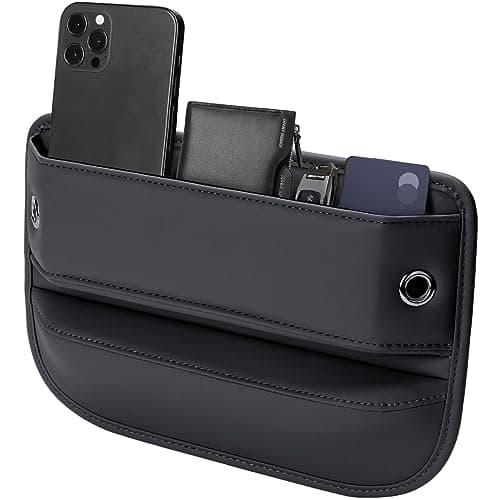 Owntow Premium Leather Seat Gap Filler Organizer, 0.2"–1.2" GapsPublishes the gap width it is designed for — 0.2" to 1.2" — and its own external dimensions, so both halves of the fitment question are answerable before you order. Owntow Premium Leather Seat Gap Filler Organizer, 0.2"–1.2" GapsPublishes the gap width it is designed for — 0.2" to 1.2" — and its own external dimensions, so both halves of the fitment question are answerable before you order. | Knowing before you buy whether it fits | $26.99 · View on Amazon #ad Price as of October 25, 2026. How we’re funded |
| 2 | 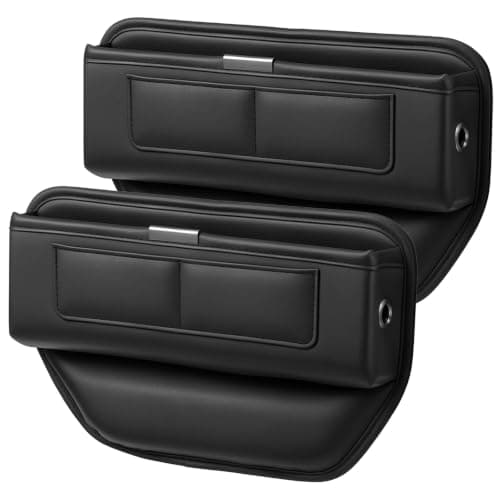 MySHUCE Premium Leather Seat Gap Filler Organizer, 2-PackThe same published 0.2"–1.2" fitment range as the single-pack pick, bought two at a time so the passenger gap closes as well as the driver's. MySHUCE Premium Leather Seat Gap Filler Organizer, 2-PackThe same published 0.2"–1.2" fitment range as the single-pack pick, bought two at a time so the passenger gap closes as well as the driver's. | Covering both sides in one purchase | $12.39 · View on Amazon #ad Price as of October 25, 2026. How we’re funded |
| 3 | 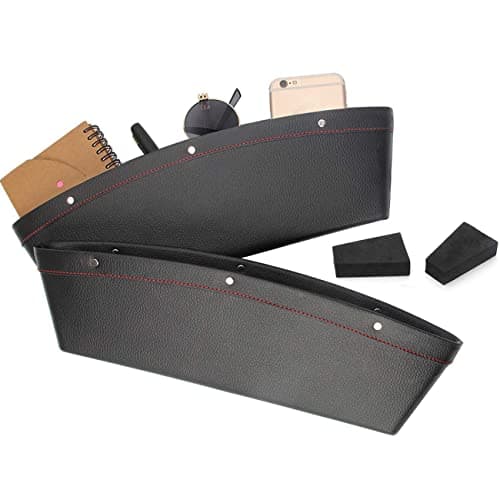 Coolrunner Car Seat Gap Organizer with Spacers, 2-SetFramed as a crevice catcher rather than a storage box, and it ships four spacers so you tune the fit to your own gap instead of hoping a fixed width lands. Coolrunner Car Seat Gap Organizer with Spacers, 2-SetFramed as a crevice catcher rather than a storage box, and it ships four spacers so you tune the fit to your own gap instead of hoping a fixed width lands. | Catching the things that fall, first | $9.99 · View on Amazon #ad Price as of October 25, 2026. How we’re funded |
#1 · Knowing before you buy whether it fits
Owntow Premium Leather Seat Gap Filler Organizer, 0.2"–1.2" Gaps
Owntow
Publishes the gap width it is designed for — 0.2" to 1.2" — and its own external dimensions, so both halves of the fitment question are answerable before you order.
Go and measure your gap now, with a ruler, at the widest point. If it is over 1.2" this product will sag into it, and no amount of "universal" in a listing changes that.
A single-pack is a deliberate choice: the driver's side gap is the one that swallows things. The passenger side rarely earns a second unit, and this one is reversible so you can choose which side it goes on.
The listing states it sits in front of the seat belt receiver without blocking seat movement, the belt or the cup holders. That is the detail to check against your own car, because a console-mounted belt buckle is exactly where 11.82" of gap filler wants to be.
What works
- Publishes an actual fitment range, which most of the category does not
- Publishes its own external dimensions as well as the gap range
- Reversible, so one unit works on either side
- Cable holes at both ends rather than a cord trapped under it
What does not
- Useless if your gap is wider than 1.2"
- One unit means the passenger gap stays open
- No published information on what holds the shape behind the leather
Skip this if
Skip it if you have measured a gap wider than 1.2". Buy a wedge-type filler that spans, not a box that drops in.
Where these numbers came from
We have not handled this product. Here is what we did instead.
#2 · Covering both sides in one purchase
MySHUCE Premium Leather Seat Gap Filler Organizer, 2-Pack
MySHUCE
The same published 0.2"–1.2" fitment range as the single-pack pick, bought two at a time so the passenger gap closes as well as the driver's.
Two units is the right default if your car has a console gap on both sides, which most do — the passenger one collects everything a passenger drops.
It publishes the same gap range as the single-pack Owntow, so the decision between them is quantity, not fitment. Measure once, at the widest point, and check it against 1.2" before you order either.
What it does not publish is its own size. The Owntow does, so if clearance around your seat belt buckle is tight, that is the one you can check on paper. The velvet lining is the detail worth noting beyond that: it is what stops keys and coins rattling in a hard-sided pocket over a rough surface.
What works
- Two units covers both front gaps
- Publishes a gap range rather than claiming universal fit
- Openings at both ends for charging cables rather than a trapped cord
- Velvet lining, so loose keys and coins do not rattle
What does not
- No published external dimensions
- Leather scuffs where the seat rubs it
- Two thin units are easier to dislodge than one braced box
- The listing names bucket seats with a high console as the best case, so a low console is a worse fit
Skip this if
Skip it if only the driver's gap is a problem. You are buying a spare you will leave in a drawer.
Where these numbers came from
We have not handled this product. Here is what we did instead.
#3 · Catching the things that fall, first
Coolrunner Car Seat Gap Organizer with Spacers, 2-Set
Coolrunner
Framed as a crevice catcher rather than a storage box, and it ships four spacers so you tune the fit to your own gap instead of hoping a fixed width lands.
There are two jobs here and they conflict: blocking the gap, and storing things in it. A catcher does the first well; a deep box does the second.
The spacers are the reason this one is here rather than any of the dozen identical-looking catchers. A fixed-width caddy either fits your gap or rattles in it; four shims let you pad it out to the width you actually have.
It still publishes no gap range, and the listing itself tells you to measure first. On this page the two products that do publish a range are the ones to check against a ruler.
What works
- Four spacers, so the fit is adjustable rather than fixed
- Two units covers both front gaps
- Water-resistant PU leather
- Cheapest gap filler on this page
What does not
- No published gap range or dimensions
- Catcher shape stores less than a box
- Shimming it is a fiddle the strap-anchored fillers do not need
Skip this if
Skip it if you want a genuine storage compartment. This is a blocker with pockets.
Where these numbers came from
We have not handled this product. Here is what we did instead.
The airbag question, answered narrowly
Many cars have a seat-mounted side airbag, which deploys from the outboard edge of the seat back — the door side, not the console side. A gap filler sits on the inboard side, between the seat and the console, which is not where that airbag is.
That is the general geometry and it is why the console-side placement is not usually an airbag question. What we are not going to do is tell you your specific car's airbag layout from memory. Your owner's manual shows it, usually with a diagram, and that is the source to use rather than us.
The retention question, which is the real risk
The genuine failure mode with these is not exotic. It is a filler held only by friction that works loose, drops into the footwell, and ends up under a pedal. That is a real hazard and it is entirely about retention.
Prefer a product that anchors — threading onto the seat belt slot is the most secure method in this category — over one that simply wedges. And if yours has already worked loose once, treat that as the answer rather than re-seating it.
What we could not find out
Any crash testing of seat gap fillers, by anyone. No maker publishes one, no independent body appears to have run one, and we have not. Anyone telling you these are crash-tested is telling you something they cannot support.
The short version
A seat gap filler that does not touch the buckle, does not touch the webbing, does not stop the belt retracting and cannot fall into the footwell is very unlikely to be a safety problem. One that fails any of those four is one, regardless of what the listing says.
Sources
Everything on this page traces back to one of these. Where a figure could not be sourced, the page says so rather than filling the gap.