Driving for a rideshare platform changes the dash cam requirement completely, and almost nothing written about dash cams accounts for it. The ordinary buyer wants evidence of what happened in front of the car. A rideshare driver wants that too, and also wants evidence of what happened inside it.
That second requirement is the whole page. It rules out every two-channel camera on this site, however good, and it introduces two specifications almost nobody thinks about until they need the footage.
What actually matters, in order
- An interior channel, obviously. Three channels — front, inside, rear. Two-channel cameras record the road behind you, not the back seat.
- Infrared on the interior camera. A cabin at night is dark, and a normal sensor sees almost nothing. IR LEDs illuminate the cabin in a wavelength the camera sees and passengers do not. Without IR, an interior camera is a night-time ornament.
- Interior field of view. This is the specification that decides whether both rear passengers are in frame or just the one behind you — and three of the five cameras on this page publish it.
- Interior resolution. It matters less than you would think: a passenger is four feet away in a cabin, which is a far easier imaging problem than a plate at fifty feet.
- Card capacity and loop length. Three channels on a long shift is a lot of data, and the card ceiling varies more than the price does.
Quick picks
| # | Product | Best for | Price |
|---|---|---|---|
| 1 | 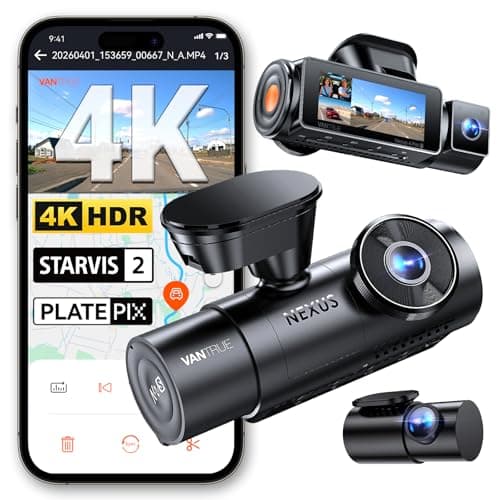 VANTRUE N4 Pro S 4K 3-Channel Dash Cam, Front + Inside + Rear165° on the inside camera is the widest interior figure published on this page, and it is the only camera here that pairs that with a named sensor generation on all three channels and IR on the one pointed at your passengers. VANTRUE N4 Pro S 4K 3-Channel Dash Cam, Front + Inside + Rear165° on the inside camera is the widest interior figure published on this page, and it is the only camera here that pairs that with a named sensor generation on all three channels and IR on the one pointed at your passengers. | The widest published interior field of view | $399.99 · View on Amazon #ad Price as of October 25, 2026. How we’re funded |
| 2 | 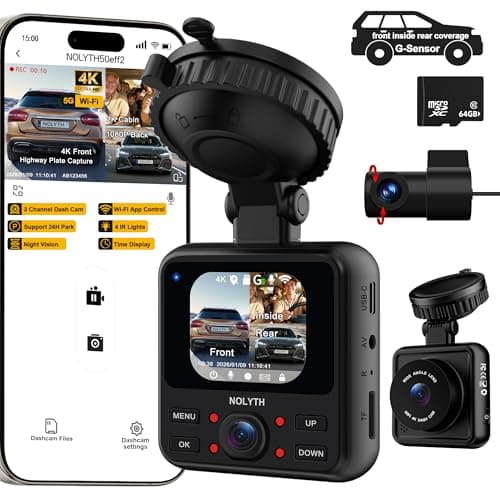 NOLYTH 4K 3-Channel Dash Cam, 4K + 2K Inside + 1080P Rear2K on the interior channel is the highest inside-camera resolution on this page, and the interior camera is the one a rideshare driver actually bought this for. NOLYTH 4K 3-Channel Dash Cam, 4K + 2K Inside + 1080P Rear2K on the interior channel is the highest inside-camera resolution on this page, and the interior camera is the one a rideshare driver actually bought this for. | The best interior resolution here | $139.99 · View on Amazon #ad Price as of October 25, 2026. How we’re funded |
| 3 | 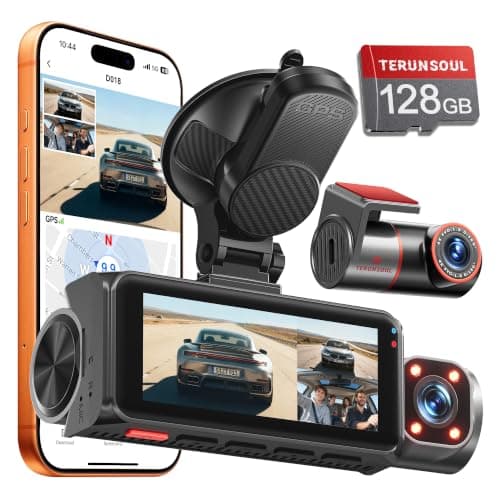 TERUNSOUl 4K + 4K + 1080P 3-Channel Dash Cam4K front AND 4K rear — the only camera here that does not cheapen the rear channel — with a field of view published for all three and a 128 GB card in the box. TERUNSOUl 4K + 4K + 1080P 3-Channel Dash Cam4K front AND 4K rear — the only camera here that does not cheapen the rear channel — with a field of view published for all three and a 128 GB card in the box. | The highest combined resolution across all three channels | $116.99 · View on Amazon #ad Price as of October 25, 2026. How we’re funded |
| 4 | 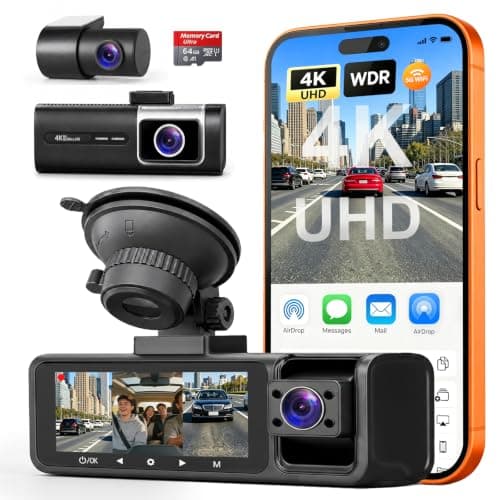 3-Channel 5G Wi-Fi Dash Cam, 4K + 1080P + 1080PThe only three-channel camera here that publishes HDR alongside the IR night vision — which is the pairing that copes with a cabin lit unevenly by streetlights. 3-Channel 5G Wi-Fi Dash Cam, 4K + 1080P + 1080PThe only three-channel camera here that publishes HDR alongside the IR night vision — which is the pairing that copes with a cabin lit unevenly by streetlights. | HDR on the interior channel | $79.99 · View on Amazon #ad Price as of October 25, 2026. How we’re funded |
| 5 | 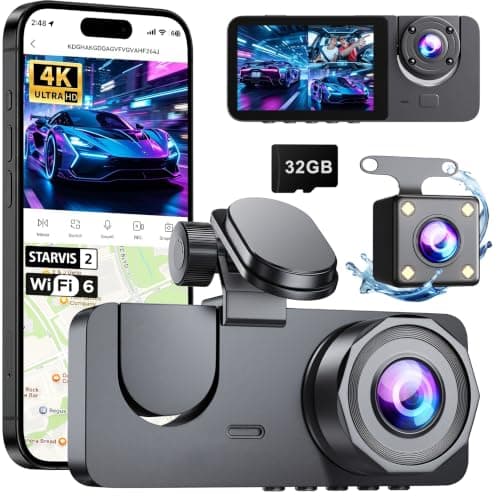 3-Channel Dash Cam, 4K Front + 1080P Inside + 1080P RearThe lowest price on this page, and it still publishes a field of view for every channel and puts a card in the box — which is more than several cameras here costing three times as much. 3-Channel Dash Cam, 4K Front + 1080P Inside + 1080P RearThe lowest price on this page, and it still publishes a field of view for every channel and puts a card in the box — which is more than several cameras here costing three times as much. | The cheapest way to get an interior channel with the numbers published | $39.98 · View on Amazon #ad Price as of October 25, 2026. How we’re funded |
#1 · The widest published interior field of view
VANTRUE N4 Pro S 4K 3-Channel Dash Cam, Front + Inside + Rear
VANTRUE
165° on the inside camera is the widest interior figure published on this page, and it is the only camera here that pairs that with a named sensor generation on all three channels and IR on the one pointed at your passengers.
Read the resolution line as three numbers rather than one. The 4K in the title is the front camera; the cabin channel — the one a rideshare driver actually bought this for — is the 1080P. That is the economy every three-channel camera makes somewhere, and this listing at least states all three figures plainly.
165° on the interior camera is the widest inside figure published on this page, and inside a car that is what decides whether both rear passengers are actually in frame rather than just the one behind you.
The listing also publishes a two-channel mode that drops the cabin camera and runs front and rear only, which it states cuts heat by about 30%. That is an unusually specific claim for this category, and heat is what kills a camera left on a windscreen through a summer.
What works
- Publishes a field of view for all three channels
- Widest published interior field of view on this page
- Names a current sensor generation — triple STARVIS 2 — rather than a generic CMOS
- IR night vision on the interior camera, which is the point of a rideshare camera
- A 1 TB card ceiling, the highest on this page, which three channels genuinely need
- Capacitor rather than a lithium battery
What does not
- The cabin channel is the lowest-resolution of the three, at 1080P
- No card included, and the hardwire kit that parking mode needs is a separate purchase
- No published operating temperature range, despite the extreme-temperature claim
- The most expensive camera on this page by some margin
- Bulkier on the glass than a two-channel unit
Skip this if
Skip it if you never carry passengers. The interior channel is the entire reason this costs what it does, and a two-channel camera gives you better value on the two views you would actually be using.
Where these numbers came from
We have not handled this product. Here is what we did instead.
#2 · The best interior resolution here
NOLYTH 4K 3-Channel Dash Cam, 4K + 2K Inside + 1080P Rear
NOLYTH
2K on the interior channel is the highest inside-camera resolution on this page, and the interior camera is the one a rideshare driver actually bought this for.
Most three-channel cameras spend their resolution budget on the front and leave the inside at 1080P. This one puts 2K inside, which is the right priority for anyone whose reason for buying is what happens in the back seat rather than in front of the car.
It also keeps the front at 4K rather than dropping all three channels down, which is a genuinely different architecture from the VANTRUE.
No field of view is published for any channel, which is the gap here — you cannot tell from the listing whether the interior camera covers both rear seats.
What works
- 2K interior channel — the highest inside resolution on this page
- Keeps 4K on the front while running all three channels
- 64 GB card in the box
- 5G Wi-Fi for faster clip transfer to a phone
What does not
- Publishes no field of view for any channel
- No stated power-storage type — capacitor versus battery is unspecified
- Newer listing with less history than the VANTRUE
Skip this if
Skip it if you park outside in a hot climate and want certainty about the power storage. VANTRUE states a capacitor; this listing does not say either way, and on a summer windshield that is the specification that decides survival.
Where these numbers came from
We have not handled this product. Here is what we did instead.
#3 · The highest combined resolution across all three channels
TERUNSOUl 4K + 4K + 1080P 3-Channel Dash Cam
TERUNSOUl
4K front AND 4K rear — the only camera here that does not cheapen the rear channel — with a field of view published for all three and a 128 GB card in the box.
Every other three-channel camera on this page drops the rear to 1080P. This one holds 4K on the rear as well as the front, which matters because the rear camera is the one pointed at the vehicle most likely to hit you.
Wi-Fi 6 on the 5.8 GHz band is the fastest transfer specification published here. On a three-channel camera generating three simultaneous files, that is not a luxury — pulling a clip off a slow camera at the roadside is genuinely painful.
What it does not publish is a power-storage type. Every other consideration on this page is answered on the listing; whether there is a capacitor or a lithium cell behind the glass is not, and on a windshield in August that is the thing you would most like to know.
What works
- 4K on the rear as well as the front — no channel drops below 1080P
- Publishes a field of view for all three channels
- Wi-Fi 6 at 5.8 GHz with a stated 20 MB/s, the fastest transfer spec on this page
- 128 GB card included and a 512 GB ceiling
- Built-in GPS writing speed and location into the footage
What does not
- No stated power-storage type — capacitor or battery is not published
- Cabin channel is 1080P while the other two are 4K
- Two 4K channels fill even a 128 GB card fast on a long shift
Skip this if
Skip it if a published capacitor matters more to you than resolution. This is the highest data rate on the page and the one camera here that will not tell you what stores its power.
Where these numbers came from
We have not handled this product. Here is what we did instead.
#4 · HDR on the interior channel
3-Channel 5G Wi-Fi Dash Cam, 4K + 1080P + 1080P
Generic (3-channel 5G Wi-Fi)
The only three-channel camera here that publishes HDR alongside the IR night vision — which is the pairing that copes with a cabin lit unevenly by streetlights.
A car cabin at night is the hardest lighting a camera on this site faces: a bright phone screen, a dark passenger, and a streetlight sweeping through every few seconds. HDR is the specification that addresses exactly that, and it is published here.
The 128 GB ceiling is the constraint to note. Three channels on a card capped at 128 GB is a shorter loop than the higher-ceiling cameras on this page allow.
What works
- HDR published on the interior channel alongside IR
- 4K front while running all three channels
- 64 GB card included
- 5G Wi-Fi
What does not
- Card support caps at 128 GB — a quarter of the TERUNSOUl's ceiling and an eighth of the VANTRUE's
- Rear and inside both at 1080P
- Unbranded listing
- No published field of view or power-storage type
Skip this if
Skip it if you drive long shifts. A 128 GB ceiling across three channels is a short loop, and on a full rideshare day that means footage from the morning is gone by evening.
Where these numbers came from
We have not handled this product. Here is what we did instead.
#5 · The cheapest way to get an interior channel with the numbers published
3-Channel Dash Cam, 4K Front + 1080P Inside + 1080P Rear
Generic (unbranded 3-channel)
The lowest price on this page, and it still publishes a field of view for every channel and puts a card in the box — which is more than several cameras here costing three times as much.
For a rideshare driver, the interior channel exists to settle a passenger dispute, and a passenger is four feet from the lens in a lit cabin. That is a much easier imaging problem than a plate at fifty feet, which is why 1080P inside is far less of a compromise than 1080P at the front.
The infrared lights are the specification to check on any interior camera, and they are published here. Without them an interior channel is a night-time ornament.
Treat the 4K on the front as a ceiling rather than a promise. No sensor is named anywhere on this listing, and resolution without a sensor behind it is a very sharp picture of not very much — which is the trade you are accepting at this price.
What works
- Publishes a field of view for all three channels at the lowest price here
- Infrared lighting on the interior channel
- 32 GB card included, so it works out of the box
- States exactly how much footage the G-sensor locks around an impact
What does not
- Names no sensor behind the 4K front claim
- No stated power-storage type
- 32 GB is a small card for three simultaneous channels
- Parking mode needs a hardwire kit that is not included
- Sold unbranded — the identical camera is listed by several sellers at the same price, and individual listings come and go
Skip this if
Skip it if you want to know what is behind the 4K number. Every camera above it on this page tells you more about its hardware, and on a long shift the 32 GB card will need replacing anyway.
Where these numbers came from
We have not handled this product. Here is what we did instead.
| Spec | VANTRUE | NOLYTH | TERUNSOUl | Generic (3-channel 5G Wi-Fi) | Generic (unbranded 3-channel) |
|---|---|---|---|---|---|
| Channels | 3 — front, inside, rear | 3 — front, inside, rear | 3 — front, rear, cabin | 3 — front, inside, rear | 3 — front, inside, rear |
| Resolution | 4K front · 2.5K rear · 1080P inside, at 30 FPS | 4K front · 2K inside · 1080P rear | 4K front · 4K rear · 1080P cabin | 4K + 1080P + 1080P | 4K front · 1080P inside · 1080P rear |
| Field of view | 155° front · 160° rear · 165° inside | Not published | 170° front · 150° rear · 150° cabin | Not published | 170° front · 150° inside · 160° rear |
| Interior camera | IR night vision | Not published | 4 IR lights | HDR, IR night vision | 4 infrared lights |
| Sensor | Triple STARVIS 2, with triple HDR and PlatePix | Not published | Not published | Not published | Not published |
| Power storage | Super capacitor | Not published | Not published | Not published | Not published |
| Parking mode | 24/7 buffered — motion and impact, from 10 seconds before the event, all three channels active | 24 hours | 24 hours — time-lapse and collision detection | 24/7 | 24 hours, low-frame-rate time-lapse |
| Card support | Up to 1 TB, none included | Not published | Not published | Up to 128 GB | Not published |
| Connectivity | 5 GHz Wi-Fi, built-in GPS, voice control | 5G Wi-Fi, app control | Dual-band Wi-Fi 6, 5.8 GHz + 2.4 GHz, up to 20 MB/s; built-in GPS | 5G Wi-Fi | Wi-Fi to a phone app for live view, download and settings |
| Warranty | 18 months, per the listing | Not published | Not published | Not published | Not published |
| Card included | Not published | 64 GB | 128 GB, supports up to 512 GB | 64 GB | 32 GB |
| Stated for | Not published | Uber, Lyft, families, new drivers | Not published | Not published | Not published |
| Display | Not published | Not published | 3.18" full-laminated | Not published | Not published |
| Optics | Not published | Not published | Not published | Not published | F/2.0 aperture, 6-layer glass, WDR |
| Event lock | Not published | Not published | Not published | Not published | 5 s before and 10 s after an impact |
Audio, and the part that is a legal question
An interior camera that records audio is recording your passengers' conversations, and whether you may do that without telling them depends on your state's consent law rather than on any dash-cam-specific rule. Some states require the consent of all parties to a recorded conversation; others require only one.
The practical answer for a rideshare driver is a sticker. Tell passengers the vehicle is recorded — most platforms already expect a notice, and a visible one removes the question entirely. Alternatively switch audio off; the video is what settles a dispute about what happened.
Nothing here is legal advice, and the state-level detail changes. Our dash cam legality guide names its sources and points you at your own state's vehicle code.
Storage: plan for a shift, not a commute
A commuter fills a card over a week. A rideshare driver on a full day fills one in an afternoon, across three simultaneous channels. Two consequences follow.
First, buy the biggest high-endurance card the camera supports — and note that the ceiling varies here from 128 GB to 1 TB between otherwise similar cameras. Second, learn where the file-lock button is before you need it. On a loop that short, an incident you do not lock is an incident that is gone by the end of the shift.
Parking mode is worth more to you than to most drivers
A rideshare vehicle spends a lot of time parked in places its owner did not choose. Every camera here advertises 24-hour parking mode, and on all of them that requires constant power the car is not supplying when it is off — which means a hardwire kit tapping a fuse that stays live, with a low-voltage cutoff so the camera stops before flattening the battery.
If a hit-and-run in a parking lot is what you are worried about rather than a collision, use time-lapse rather than an impact trigger. An impact trigger only starts recording once something has already hit you hard enough to register.
What we could not tell you
Which of these produces the most usable interior footage at night. That needs a real footage comparison in controlled lighting and we do not do that — the specialist dash cam publications do it properly and are worth reading before a large purchase. What we can do is tell you which cameras publish an interior field of view, an IR specification and a power-storage type, and which leave those rows empty.
How we picked these
Three channels was the entry requirement — a two-channel camera cannot do this job at any price. After that: published interior specification first, IR second, card ceiling third, front resolution last. Every figure is the maker's own and cited on the card. We have not tested any of them.
Sources
Everything on this page traces back to one of these. Where a figure could not be sourced, the page says so rather than filling the gap.
- VANTRUE N4 Pro S 4K 3 Channel Dash Cam, 155°/160°/165° field of view, triple STARVIS 2, IR night vision, super capacitor, 1TB max — retailer listing, Amazon.com (retrieved 2026-10-14)
- NOLYTH 4K 3-Channel dash cam, 4K + 2K inside + 1080P rear, for Uber/Lyft — retailer listing, Amazon.com (retrieved 2026-09-09)