A note on prices before anything else: we do not print them in body copy anywhere on this site, because a price typed into a sentence is out of date the week after it is written. Every card on this page shows a live price if the price layer has verified one today, and says check price if it has not. Nothing in between.
What we can talk about is what the cheaper end of this category gives up, which has changed a lot and is now less than people expect.
What you still get at the budget end
- A supercapacitor. This is no longer a premium feature and you should not accept a lithium battery to save money — it is the component most likely to fail in a hot car.
- 4K front recording. Real, and worth having, though it is only half the story without a good sensor.
- GPS and Wi-Fi. Both are effectively standard now, and GPS is what timestamps speed and location alongside the footage.
- Loop recording and a G-sensor. Also standard.
- Often a bundled memory card, usually 32 or 64 GB, which you should plan to replace with something larger and high-endurance. Check this one rather than assuming — one camera on this page ships without a card at all.
What you give up
- A named sensor, usually. Most budget listings advertise megapixels rather than a Sony part number, and megapixels do not tell you how the camera behaves at night — but the top pick on this page is the exception, and it is the reason it is the top pick.
- Rear resolution. Almost always 1080p, which is the camera pointed at the vehicle most likely to hit you.
- A published operating temperature range. One camera on this page publishes one, which is notable at any price.
- Firmware support. Cheaper brands update less and disappear more often, which matters for a device that has to keep writing files for years.
Quick picks
| # | Product | Best for | Price |
|---|---|---|---|
| 1 | 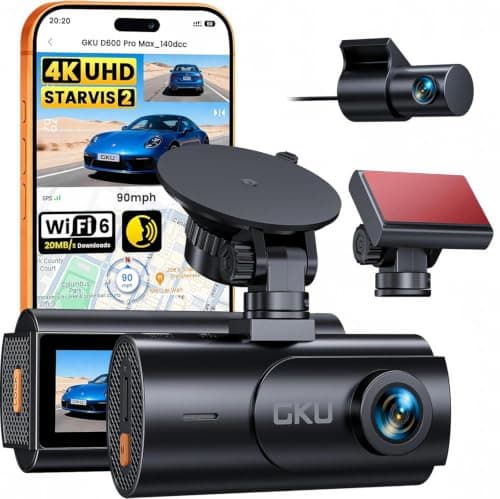 GKU D600 Pro Max 4K Dual Dash Cam, STARVIS 2The cheapest camera on this site that names its sensor rather than quoting megapixels — a Sony STARVIS 2, which is the part that decides whether a plate is readable at night. GKU D600 Pro Max 4K Dual Dash Cam, STARVIS 2The cheapest camera on this site that names its sensor rather than quoting megapixels — a Sony STARVIS 2, which is the part that decides whether a plate is readable at night. | A named sensor at the bottom of the price range | $79.99 · View on Amazon #ad Price as of October 25, 2026. How we’re funded |
| 2 | 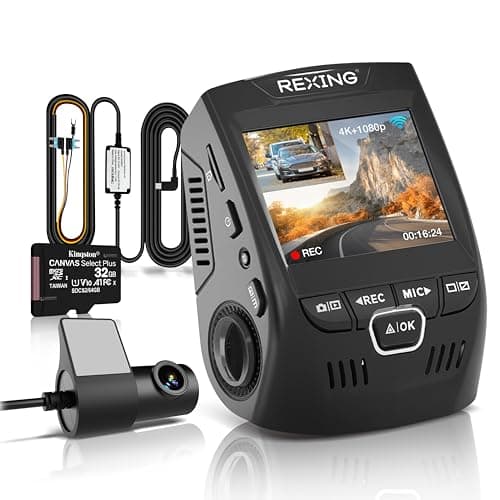 REXING V1P 4K Dual-Channel Dash Cam4K front, 1080p rear, 170°, and the only camera here that publishes what its supercapacitor tolerates: -20°F to 176°F. It also ships the hardwire kit parking mode actually needs. REXING V1P 4K Dual-Channel Dash Cam4K front, 1080p rear, 170°, and the only camera here that publishes what its supercapacitor tolerates: -20°F to 176°F. It also ships the hardwire kit parking mode actually needs. | A published temperature range, and the kit to use parking mode | $149.99 · View on Amazon #ad Price as of October 25, 2026. How we’re funded |
| 3 | 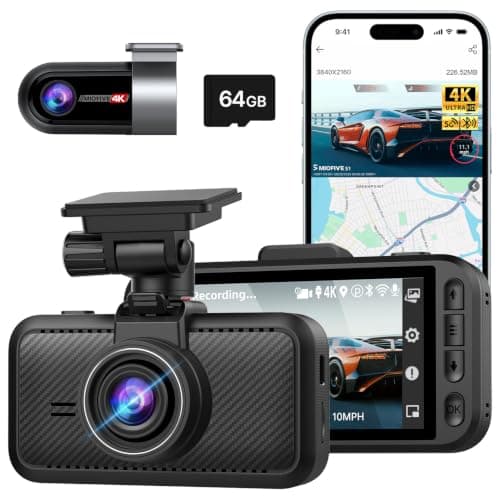 4K Front + 4K Rear Dual Dash Cam with 64GB CardThe only camera on this page that claims 4K at the rear as well as the front, with a supercapacitor and a 64 GB card in the box. 4K Front + 4K Rear Dual Dash Cam with 64GB CardThe only camera on this page that claims 4K at the rear as well as the front, with a supercapacitor and a 64 GB card in the box. | 4K at both ends | $134.99 · View on Amazon #ad Price as of October 25, 2026. How we’re funded |
| 4 | 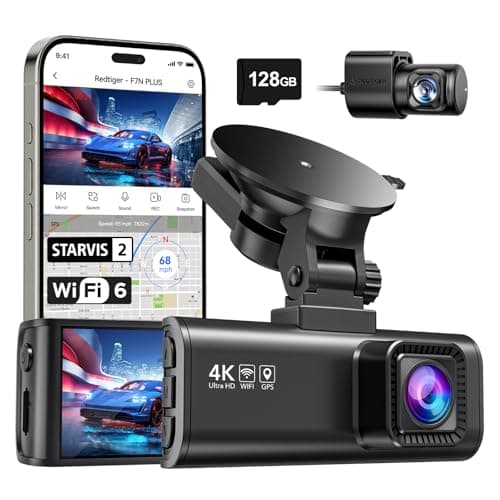 REDTIGER F7NP 4K Front + Rear Dash Cam, 24H Parking ModeThe only camera here whose listing states plainly that 24-hour parking mode needs a hardwire kit — which is true of all of them and admitted by almost none. REDTIGER F7NP 4K Front + Rear Dash Cam, 24H Parking ModeThe only camera here whose listing states plainly that 24-hour parking mode needs a hardwire kit — which is true of all of them and admitted by almost none. | Parking surveillance, done honestly | $149.98 · View on Amazon #ad Price as of October 25, 2026. How we’re funded |
#1 · A named sensor at the bottom of the price range
GKU D600 Pro Max 4K Dual Dash Cam, STARVIS 2
GKU
The cheapest camera on this site that names its sensor rather than quoting megapixels — a Sony STARVIS 2, which is the part that decides whether a plate is readable at night.
A named sensor is the one specification that predicts night performance, and at this price it is usually the first thing to disappear behind a megapixel number. STARVIS 2 is the current Sony low-light part and it is stated outright here.
Pre-recording is the parking feature worth understanding. An impact trigger starts recording once something has already hit you; pre-recording keeps a rolling buffer, so you get the thirty seconds before the hit as well as after it.
Read the HDR line carefully, because it is a trade the listing states and most buyers miss: HDR only runs with the front camera alone. Plug the rear camera in and you lose it.
What works
- Names a Sony STARVIS 2 sensor rather than publishing megapixels
- Three parking modes including a pre-event buffer
- 5.8 GHz Wi-Fi 6 at up to 20 MB/s, the fastest transfer figure on this page
- Supercapacitor and built-in GPS
What does not
- No memory card in the box on this version
- HDR is unavailable whenever the rear camera is connected, per the listing
- Parking mode needs a hardwire kit sold separately
- 1080p rear
Skip this if
Skip it if you want to unbox it and drive. There is no card in this version and no hardwire kit, so budget for both before the headline features work.
Where these numbers came from
We have not handled this product. Here is what we did instead.
#2 · A published temperature range, and the kit to use parking mode
REXING V1P 4K Dual-Channel Dash Cam
REXING
4K front, 1080p rear, 170°, and the only camera here that publishes what its supercapacitor tolerates: -20°F to 176°F. It also ships the hardwire kit parking mode actually needs.
170° is the sweet spot for a front camera. Wider captures more lanes and distorts plates at the edges; narrower misses the car that came in from the side.
A windshield in direct summer sun goes well past 140°F. A camera rated to 176°F has margin; one with no published rating is an unknown you are mounting to glass.
The hardwire kit in the box is worth more than it sounds. Every camera on this site advertises parking mode, and on all of them it needs constant power the car does not supply when it is off — which normally means a second purchase before the headline feature works at all.
What works
- Publishes an operating temperature range
- Hardwire kit and a 32 GB card included, so parking mode works out of the box
- Both parking modes: impact trigger and 24/7 time-lapse
- Long-standing model from an established brand
What does not
- 1080p rear
- No GPS on this model
- No published sensor model
- 256 GB card ceiling, lower than the newer cameras here
Skip this if
Skip it if the night-time rear plate is what you care about. 1080p at night is not a plate reader.
Where these numbers came from
We have not handled this product. Here is what we did instead.
#3 · 4K at both ends
4K Front + 4K Rear Dual Dash Cam with 64GB Card
Generic (dual 4K)
The only camera on this page that claims 4K at the rear as well as the front, with a supercapacitor and a 64 GB card in the box.
4K front and rear doubles your storage burn. A 64 GB card at dual 4K is a short loop — budget for a 256 GB high-endurance card on day one.
No named sensor. Resolution is easy to print on a box; sensor quality is what makes a night plate readable, and this listing does not tell you what is behind the lens.
What works
- 4K at both ends
- Supercapacitor
- Card, Bluetooth and GPS included
What does not
- No published sensor model
- Dual 4K fills a card fast
- Unbranded listing
Skip this if
Skip it if you will not buy a bigger card. At dual 4K the supplied 64 GB loops in well under two hours of driving.
Where these numbers came from
We have not handled this product. Here is what we did instead.
#4 · Parking surveillance, done honestly
REDTIGER F7NP 4K Front + Rear Dash Cam, 24H Parking Mode
REDTIGER
The only camera here whose listing states plainly that 24-hour parking mode needs a hardwire kit — which is true of all of them and admitted by almost none.
Every 24-hour parking claim in this category assumes constant power. Your cigarette lighter socket usually dies with the ignition, so the camera dies with it.
A hardwire kit taps a fuse that stays live and includes a low-voltage cutoff so the camera stops before it flattens your battery. Budget for the kit and, if you are not comfortable behind a fuse panel, for the fitting.
REDTIGER saying this in the product title is the single most honest line in this category, and it is why this camera is on the page.
What works
- States the hardwire requirement up front
- STARVIS 2 sensor
- 5.8 GHz Wi-Fi
- Card included
What does not
- The hardwire kit is an extra purchase and an extra job
- Rear resolution not stated as 4K
- Fuse-tap installation voids nothing but does require care
Skip this if
Skip it if you will not hardwire it. Without constant power you have bought a driving camera, and the cheaper models on this page do that too.
Where these numbers came from
We have not handled this product. Here is what we did instead.
| Spec | GKU | REXING | Generic (dual 4K) | REDTIGER |
|---|---|---|---|---|
| Front resolution | 3840 x 2160 (4K UHD) | 3840 x 2160 (4K UHD) | 4K | 4K, 170° wide angle |
| Rear resolution | 1080P | 1080p | 4K | Not published |
| Field of view | 170° front · 150° rear | 170°, 6-layer glass lens | Not published | Not published |
| Sensor | Sony STARVIS 2 (front) | Not published | Not published | Sony STARVIS 2 |
| Power storage | Supercapacitor | Supercapacitor | Supercapacitor | Not published |
| Connectivity | 5.8 GHz Wi-Fi 6 and 2.4 GHz, up to 20 MB/s; built-in GPS | Wi-Fi, app | 5 GHz Wi-Fi, Bluetooth, GPS | 5.8 GHz Wi-Fi, 20 MB/s download |
| Parking | Time-lapse, collision detection, and pre-recording 30–60 s around an event | Vibration-triggered, or 24/7 time-lapse | Not published | Not published |
| Card support | Up to 512 GB — no card in the box | Up to 256 GB | Not published | Not published |
| Operating range | Not published | -20°F to 176°F | Not published | Not published |
| In the box | Not published | 32 GB microSD card and smart hardwire kit | Not published | Not published |
| Display | Not published | Not published | 3.0" IPS | Not published |
| Card included | Not published | Not published | 64 GB | Yes |
| Parking mode | Not published | Not published | Not published | 24H (hardwire kit required, stated on the listing) |
| Detection | Not published | Not published | Not published | G-sensor incident detection |
| Hardwire kit included | Not published | Not published | Not published | Not published |
The one place not to save money
Where the money actually goes at the top end
Sensor, rear resolution, build quality, and firmware. Not resolution — everything records 4K now. If you are deciding whether to spend more, spend it on a named low-light sensor and a rear camera above 1080p, in that order.
How we picked these
Published specification only, with the supercapacitor treated as a requirement rather than a feature. We have not tested any of these cameras. Every figure is the maker's own, cited on the card, and every pick names someone who should skip it.
Sources
Everything on this page traces back to one of these. Where a figure could not be sourced, the page says so rather than filling the gap.