VIOFO is the brand people recommend to each other and the brand this site had never covered. That gap is worth closing because of how VIOFO writes its listings rather than because of any loyalty: this is a company that publishes the part number of the sensor, states what the generation change was worth, and then volunteers the configuration in which its own headline specification stops working.
This review is read from that published specification, not from a camera we have driven with. We will be explicit about what that cannot settle at the end. What it can settle is whether the A229 Plus is making checkable claims, and on that it is the strongest listing in its price band.
The verdict, and who it is for
This is the camera for someone who has worked out that the sensor matters more than the resolution and wants both channels covered. You are paying about a 4K price for a 2K camera, and what you get for the difference is an equal 1440P at both ends, a named Sony part in each, and a company that tells you where the compromises are.
It is the wrong camera for two buyers. If you carry passengers for money, this has no cabin channel and the rideshare page on this site is the right one. And if you want the biggest number on the box, a 4K front camera costs less elsewhere — you will simply not be able to find out what sensor is behind it.
The sensor, which is the actual product
Two Sony STARVIS 2 IMX675 sensors, named in the title and again in the first feature bullet, and the listing states this is the first front-and-rear dash cam to carry two of them. Then it does the thing almost nobody in this category does and quantifies the generation: 2.5 times the dynamic range and 2.5 times the light sensitivity, compared with STARVIS.
Dynamic range is the right figure to lead with, because the hard scene for a dash cam is not a dark one — it is a dark one with a bright light in it. Oncoming high beams on an unlit road, a tunnel mouth at midday, a wet surface under sodium lamps. All three are cases where the plate you want sits either in the blown highlight or in the crushed shadow, and dynamic range is what decides which.
What makes this worth paying for is not the number itself, it is that the number exists and is attached to a part you can look up. Three cameras in the comparison table below say STARVIS 2 and name nothing — including VIOFO's own more expensive A229 Pro, whose listing carries no feature bullets at all.
Equal resolution at both ends, which is rarer than it sounds
1440P front and 1440P rear. The front channel can run to 60 FPS. That configuration is unusual and it is the second real argument for this camera.
The standard arrangement in this market is a 4K front paired with a 1080P rear, sold on the 4K. The rear camera is the one that films the vehicle that rear-ends you, which is the single most common collision a dash cam is bought for, and it is the channel every maker economizes on. Two matched 1440P channels is a better-balanced camera than a 4K-and-1080P pair, even though it reads worse on a shelf.
| Camera | Front / rear resolution | Sensor part named | Channels | Card included | Hardwire kit |
|---|---|---|---|---|---|
| VIOFO A229 Plus | 1440P / 1440P | IMX675 x2 | 2 | No | HK4, separate |
| VIOFO A229 Plus 3CH | 1440P / 1440P, plus 1080P cabin | Dual STARVIS 2, channel unstated | 3 | No | Separate |
| VIOFO A119 Mini 2 | 1440P front only | IMX675 | 1 | No | HK4, separate |
| VIOFO A229 Pro | 4K front, rear not published | Not published | 2 | Not published | Not published |
| REDTIGER F7NP | 4K / 1080P | Not published | 2 | Yes | Separate |
The bottom two rows are the interesting comparison. The REDTIGER gives you a bigger front number and a card in the box for less money, and tells you nothing about its sensor. The A229 Pro gives you a bigger front number for more money and tells you even less. The A229 Plus is the only row where every cell is filled in.
The compromise VIOFO volunteers
In practice you will choose HDR and run at 30 FPS, because for evidence a balanced exposure beats smooth motion every time. A 60 FPS clip of a blown-out headlight is not better than a 30 FPS clip with a readable plate in it. Which means the 60 FPS in the specification is a number you will probably turn off, and it is to VIOFO's credit that you find this out from the listing rather than from the menu three weeks later.
The A119 Mini 2 has the same conflict stated in the same way: enable HDR and the frame rate drops from 60 to 30. It appears to be a platform characteristic rather than a fault, and the pattern of disclosing it is the thing worth noting.
What is not in the box
Two things, and both cost money, and together they change the comparison materially.
There is no memory card. The listing says so outright and recommends VIOFO's own industrial cards in 128, 256 or 512 GB. A high-endurance card is not optional on a camera that overwrites its storage continuously, so this is a real line item — our memory card page covers which cards publish a figure worth comparing.
There is no HK4 hardwire cable, and without it none of the three parking modes work. That is worth being precise about, because parking mode is listed as a headline feature: auto event detection with a 15-second buffer before and 30 after, time-lapse, and low bitrate. All three need power the car is not supplying with the ignition off. The camera as shipped is a driving camera.
Against a REDTIGER F7NP that includes a card, the price gap is wider than the sticker suggests. That is a fair point against this camera and it does not change the sensor argument.
The rest of the specification
- Quad-mode GPS — GPS, BEIDOU, GALILEO and GLONASS — which is what makes the speed and route overlay dependable rather than approximate, and sets the clock without you.
- 5 GHz Wi-Fi to the VIOFO app for live view, download and settings, which is a car-park-range feature and not remote viewing.
- Twelve voice commands, including locking a clip, which is the one you want hands-free after an incident.
- A supercapacitor rather than a lithium battery. This is the component that lets the camera finish writing a file after power is cut and the one that does not swell in a hot car.
- 3.86 by 2.36 by 1.77 inches, so it is a presence on the glass rather than a hidden camera — the A119 minis are the discreet option in this family.
- 18 months of warranty, extended by six on registration.
The one figure missing is an operating temperature range. VIOFO publishes 5 F to 149 F for both A119 minis and nothing for this camera, despite making the same supercapacitor claim. That is an odd omission in an otherwise unusually complete listing.
Quick picks
| # | Product | Best for | Price |
|---|---|---|---|
| 1 | 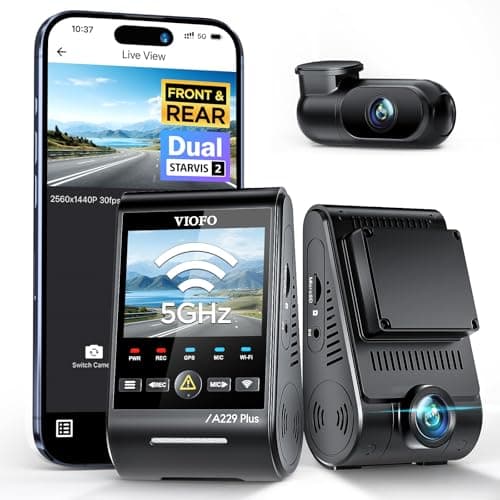 VIOFO A229 Plus 2CH Dash Cam, Dual STARVIS 2 IMX675, 1440P Front and RearThe only camera on this site that names the Sony part number in both channels and publishes what the newer sensor generation is worth — 2.5 times the dynamic range and 2.5 times the light sensitivity of the STARVIS it replaced. You pay for that in resolution: this is a 2K camera at a 4K price. | A sensor you can actually verify, front and rear | $189.99 · View on Amazon #ad Price as of October 25, 2026. How we’re funded |
| 2 | 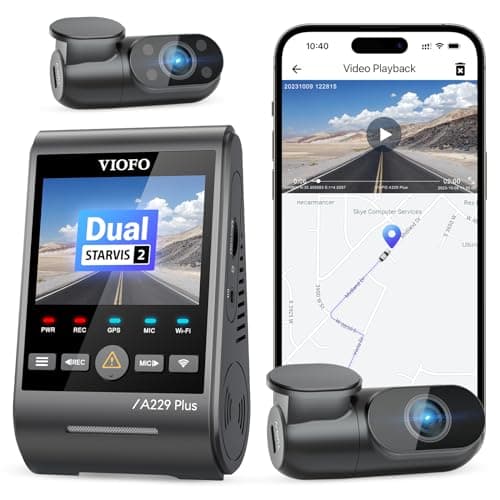 VIOFO A229 Plus 3-Channel Dash Cam, 1440P + 1440P + 1080PThe same camera as the two-channel A229 Plus with an interior channel bolted on, for roughly twenty dollars more. The interior channel is the 1080P one, which is the economy every three-channel camera makes somewhere. | The A229 Plus with a cabin camera added | $209.95 · View on Amazon #ad Price as of October 25, 2026. How we’re funded |
| 3 | 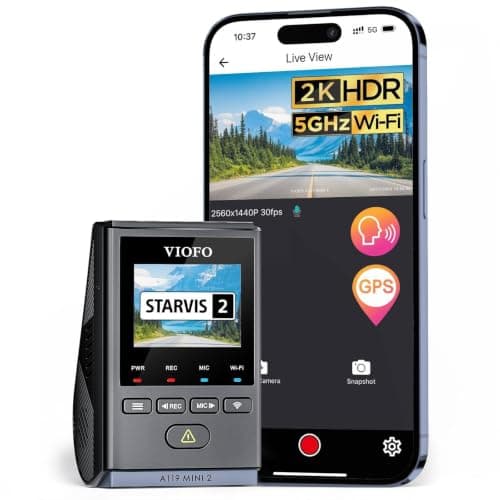 VIOFO A119 Mini 2 Front Dash Cam, STARVIS 2 IMX675, 1440P 60 FPSA named STARVIS 2 IMX675 sensor and a published F1.6 seven-glass lens in a body under three inches tall, for roughly a third less than the two-channel version. It is one channel only — there is no rear camera and no way to add one. | The cheapest camera here that names its Sony sensor | Check price on Amazon #ad We show a price only when we can verify one. How we’re funded |
| 4 | 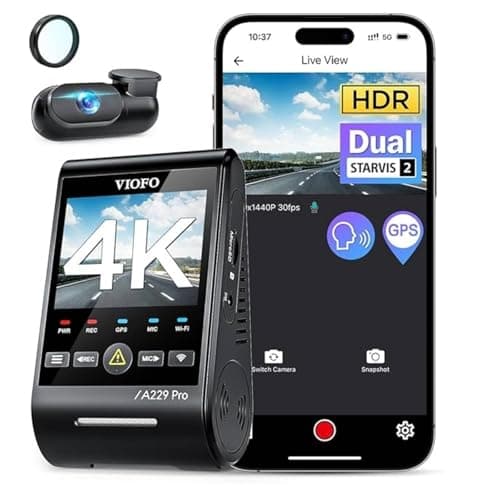 VIOFO A229 Pro 4K HDR Dash Cam, Dual STARVIS 2, Front and RearThe A229 Plus with a 4K front channel instead of 2K, at a meaningful premium. The listing is unusually short on detail for a camera at this price — it states dual STARVIS 2 and 4K HDR and very little else. | The 4K step up from the A229 Plus | $279.99 · View on Amazon #ad Price as of October 25, 2026. How we’re funded |
| 5 | 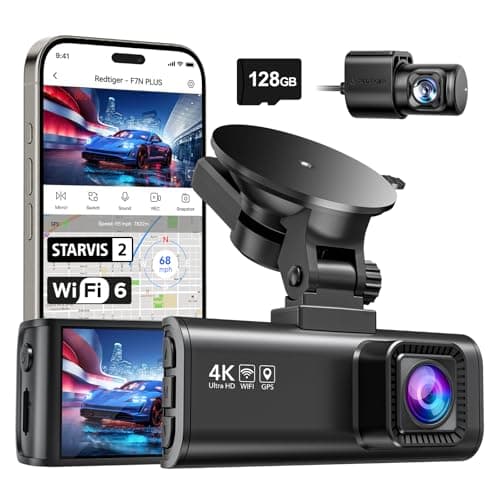 REDTIGER F7NP 4K Front + Rear Dash Cam, 24H Parking ModeThe only camera here whose listing states plainly that 24-hour parking mode needs a hardwire kit — which is true of all of them and admitted by almost none. | Parking surveillance, done honestly | $149.98 · View on Amazon #ad Price as of October 25, 2026. How we’re funded |
#1 · A sensor you can actually verify, front and rear
VIOFO A229 Plus 2CH Dash Cam, Dual STARVIS 2 IMX675, 1440P Front and Rear
VIOFO
The only camera on this site that names the Sony part number in both channels and publishes what the newer sensor generation is worth — 2.5 times the dynamic range and 2.5 times the light sensitivity of the STARVIS it replaced. You pay for that in resolution: this is a 2K camera at a 4K price.
The number that matters here is not 1440P, it is IMX675. Almost every camera in this price band says "STARVIS" or "STARVIS 2" somewhere in its title and then never names the part, which leaves the claim unverifiable. This listing names it twice and tells you what the generation change bought: 2.5 times the dynamic range and 2.5 times the light sensitivity of the sensor before it. Dynamic range is the specification that decides whether a plate is readable against oncoming headlights.
Then read the HDR note, because it is the honest catch. The 60 FPS front recording and HDR are mutually exclusive — you choose smooth motion or balanced exposure, not both. For evidence, HDR at 30 FPS is almost always the right choice, which means the headline 60 FPS is a specification you will probably turn off.
Two things are not in the box and both cost money: the memory card and the HK4 hardwire kit that all three parking modes require. Budget for both before comparing this with a camera that bundles a card.
What works
- Names the Sony sensor part number — IMX675 — on both channels
- Publishes a quantified generational gain rather than a vague night-vision claim
- Equal resolution front and rear, which is rare; most pair 4K front with 1080P rear
- States the HDR and frame-rate conflict instead of hiding it
- Quad-mode GPS, so the speed and route overlay is dependable
- Supercapacitor rather than a lithium battery
- 18-month warranty, extendable to 24 on registration
What does not
- 2K, not 4K, at a price where 4K cameras exist
- No memory card included at all
- Parking mode needs the HK4 kit as a separate purchase
- Cannot run 60 FPS and HDR together
- No published operating temperature range despite the supercapacitor claim
- No interior channel, so it is the wrong camera for rideshare
Skip this if
Skip it if the number on the box is what you are buying. A 4K front channel costs less elsewhere, and if you will never check whether the sensor is named, you are paying this premium for a specification you do not intend to read.
Where these numbers came from
We have not handled this product. Here is what we did instead.
#2 · The A229 Plus with a cabin camera added
VIOFO A229 Plus 3-Channel Dash Cam, 1440P + 1440P + 1080P
VIOFO
The same camera as the two-channel A229 Plus with an interior channel bolted on, for roughly twenty dollars more. The interior channel is the 1080P one, which is the economy every three-channel camera makes somewhere.
This exists so you do not have to choose between a verifiable sensor and a cabin camera. The front and rear channels are the same 1440P as the two-channel model; the third is 1080P.
The listing says dual STARVIS 2 on a three-channel camera, which means one of the three channels is not on that sensor. It does not say which, and on the balance of the specification it is almost certainly the 1080P interior channel — but that is our inference, not a published figure, and we are flagging it as such.
If the cabin camera is the whole reason you are buying, the rideshare page on this site ranks cameras on interior field of view and infrared, neither of which this listing publishes.
What works
- Adds an interior channel to the A229 Plus platform for a small premium
- Front and rear stay at 1440P rather than dropping to make room
- 3-channel HDR
- Supercapacitor
What does not
- Says dual STARVIS 2 on a three-channel camera without saying which channel misses out
- Publishes no interior field of view and no infrared specification
- Interior channel is 1080P
- No card, no hardwire kit
Skip this if
Skip it if the cabin camera is the point of the purchase. The cameras built for that publish an interior field of view and an infrared specification, and this listing publishes neither.
Where these numbers came from
We have not handled this product. Here is what we did instead.
#3 · The cheapest camera here that names its Sony sensor
VIOFO A119 Mini 2 Front Dash Cam, STARVIS 2 IMX675, 1440P 60 FPS
VIOFO
A named STARVIS 2 IMX675 sensor and a published F1.6 seven-glass lens in a body under three inches tall, for roughly a third less than the two-channel version. It is one channel only — there is no rear camera and no way to add one.
This is the cheapest route to a verifiable sensor. The IMX675 here is the same part VIOFO puts in both channels of the A229 Plus, so the night-time image quality argument is largely the same argument — you are giving up the rear camera, not the sensor.
The published temperature range is worth as much as the sensor name. 5 F to 149 F is a real, checkable figure, and a camera that lives on a windshield will see both ends of it. Most listings in this category say "temperature proof" and stop.
Size is the other reason to want this one. At 2.93 inches tall it genuinely hides behind a rear-view mirror, which matters if you want the camera to be unobtrusive rather than a second screen in your eyeline.
What works
- Names the Sony part number — STARVIS 2 IMX675
- Publishes a real operating temperature range, 5 F to 149 F
- Publishes the lens: 7-glass, F1.6
- Small enough to hide behind the mirror
- Supercapacitor, built-in GPS, 5 GHz Wi-Fi
- The listing names the exact hardwire kit ASIN instead of leaving you to guess
What does not
- Front channel only — no rear camera and no upgrade path to one
- No memory card included
- Parking mode needs the separate HK4 kit
- HDR costs you half the frame rate
- No interior camera, so it cannot serve rideshare or a monitored driver
Skip this if
Skip it if you want the rear covered. The camera that films the vehicle that rear-ends you is the one this does not have, and no accessory adds it later.
Where these numbers came from
We have not handled this product. Here is what we did instead.
#4 · The 4K step up from the A229 Plus
VIOFO A229 Pro 4K HDR Dash Cam, Dual STARVIS 2, Front and Rear
VIOFO
The A229 Plus with a 4K front channel instead of 2K, at a meaningful premium. The listing is unusually short on detail for a camera at this price — it states dual STARVIS 2 and 4K HDR and very little else.
This is the model people land on when they search for the A229 and want the bigger number. It is the step up in resolution, and on the evidence the listing publishes it is also a step down in disclosure.
The A229 Plus listing names IMX675 twice, quantifies the sensor generation, states the HDR frame-rate conflict and lists the parking modes. This one states dual STARVIS 2, 4K and HDR. Everything else — rear resolution, part number, warranty, temperature, what the parking modes do — is simply not there.
That is not a reason to assume the camera is worse. It is a reason not to pay the premium on specification you cannot read, which is the whole argument of the page you are on.
What works
- 4K front channel on the A229 platform
- Dual STARVIS 2 claim, front and rear
- HDR on both channels
What does not
- Does not name the Sony sensor part number, where the cheaper A229 Plus does
- Publishes no rear resolution
- Carries no feature bullets at all in the listing body
- Significantly more expensive than the A229 Plus
Skip this if
Skip it if you are buying on published specification. The cheaper A229 Plus tells you more about itself than this does, and on this site that is the deciding factor rather than a tiebreaker.
Where these numbers came from
We have not handled this product. Here is what we did instead.
#5 · Parking surveillance, done honestly
REDTIGER F7NP 4K Front + Rear Dash Cam, 24H Parking Mode
REDTIGER
The only camera here whose listing states plainly that 24-hour parking mode needs a hardwire kit — which is true of all of them and admitted by almost none.
Every 24-hour parking claim in this category assumes constant power. Your cigarette lighter socket usually dies with the ignition, so the camera dies with it.
A hardwire kit taps a fuse that stays live and includes a low-voltage cutoff so the camera stops before it flattens your battery. Budget for the kit and, if you are not comfortable behind a fuse panel, for the fitting.
REDTIGER saying this in the product title is the single most honest line in this category, and it is why this camera is on the page.
What works
- States the hardwire requirement up front
- STARVIS 2 sensor
- 5.8 GHz Wi-Fi
- Card included
What does not
- The hardwire kit is an extra purchase and an extra job
- Rear resolution not stated as 4K
- Fuse-tap installation voids nothing but does require care
Skip this if
Skip it if you will not hardwire it. Without constant power you have bought a driving camera, and the cheaper models on this page do that too.
Where these numbers came from
We have not handled this product. Here is what we did instead.
| Spec | VIOFO | VIOFO | VIOFO | VIOFO | REDTIGER |
|---|---|---|---|---|---|
| Channels | 2 — front and rear | 3 — front, inside, rear | 1 — front only; no rear camera support | 2 — front and rear | Not published |
| Resolution | 1440P front + 1440P rear; front up to 60 FPS | 1440P + 1440P + 1080P | 1440P at 60 FPS, or up to 2592x1944P at 30 FPS | 4K front, with HDR | Not published |
| Sensor | Two Sony STARVIS 2 IMX675 | Dual STARVIS 2, per the listing | Sony STARVIS 2 IMX675 | Dual STARVIS 2 | Sony STARVIS 2 |
| Published sensor gain | 2.5x dynamic range, 2.5x light sensitivity vs STARVIS | Not published | Not published | Not published | Not published |
| HDR trade-off | Front 1440P 60 FPS is unavailable while HDR is enabled | Not published | With HDR enabled the frame rate drops from 60 to 30 FPS | Not published | Not published |
| GPS | Quad-mode — GPS, BEIDOU, GALILEO, GLONASS | Yes, per the A229 Plus platform | Built-in — route, speed and time written into the file | Not published | Not published |
| Wi-Fi | 5 GHz | Not published | 5 GHz | Not published | Not published |
| Voice control | 12 commands | Not published | Not published | Not published | Not published |
| Power storage | Supercapacitor | Supercapacitor | Supercapacitor | Not published | Not published |
| Parking modes | 3 — auto event detection buffered 15s before / 30s after, time-lapse, low bitrate | Not published | 3 — buffered auto event detection (15s before / 30s after), low bitrate, time-lapse | Not published | Not published |
| Hardwire kit | HK4, sold separately — parking mode does not work without it | Sold separately, as on the 2-channel model | HK4, sold separately (the listing names ASIN B09MRVP2PX) | Not published | Not published |
| Card included | None. 128 / 256 / 512 GB supported | None | None. Class 10 or UHS-I required, up to 512 GB | Not published | Yes |
| Dimensions | 3.86 x 2.36 x 1.77 in | Not published | 2.93 x 1.81 x 1.63 in | Not published | Not published |
| Warranty | 18 months, plus 6 months on registration | 18 months | 18 months, plus 6 months on registration | Not published | Not published |
| Operating temperature range | Not published | Not published | 5 F to 149 F | Not published | Not published |
| HDR | Not published | 3-channel HDR | Not published | Not published | Not published |
| Interior camera IR | Not published | Not published | Not published | Not published | Not published |
| Lens | Not published | Not published | 7-glass, F1.6 aperture, 140 degrees | Not published | Not published |
| Sensor part number | Not published | Not published | Not published | Not published | Not published |
| Rear resolution | Not published | Not published | Not published | Not published | Not published |
| Published feature bullets | Not published | Not published | Not published | None in the listing body | Not published |
| Front resolution | Not published | Not published | Not published | Not published | 4K, 170° wide angle |
| Parking mode | Not published | Not published | Not published | Not published | 24H (hardwire kit required, stated on the listing) |
| Connectivity | Not published | Not published | Not published | Not published | 5.8 GHz Wi-Fi, 20 MB/s download |
| Detection | Not published | Not published | Not published | Not published | G-sensor incident detection |
| Hardwire kit included | Not published | Not published | Not published | Not published | Not published |
Which A229 you should actually buy
There are three and the names do not help.
The A229 Plus 2CH, reviewed here, is front and rear at a matched 1440P. The A229 Plus 3CH adds a 1080P cabin camera for about twenty dollars more and keeps the front and rear where they are — take it if you carry passengers, but note that its listing says dual STARVIS 2 on a three-channel camera and does not say which channel misses out. The A229 Pro steps the front channel to 4K for a substantial premium and publishes nothing else at all.
On the evidence available, the Plus 2CH is the one to buy. It is the model in the family that documents itself, and on a page arguing that you should buy on published specification, that is not a tiebreaker — it is the conclusion.
What we cannot tell you
We have not mounted this camera, driven it at night, or compared its footage with anything. Cabin Command does not do that work and does not have a page anywhere that implies otherwise.
So three things stay open. We cannot tell you how VIOFO's processing uses the IMX675 it has — two cameras on the same sensor can look different. We cannot confirm the 2.5-times figure independently; it is the maker's claim about its own product and we have reported it as such. And we cannot tell you about reliability over years, which is the specification nobody publishes and the one that decides whether a camera was a good purchase.
Sources
Everything on this page traces back to one of these. Where a figure could not be sourced, the page says so rather than filling the gap.
- VIOFO A229 Plus Dash Cam Front and Rear, two Sony STARVIS 2 IMX675 sensors stated at 2.5x dynamic range and 2.5x light sensitivity versus STARVIS, 1440P+1440P with front up to 60fps, front 60fps unavailable with HDR enabled, quad-mode GPS, 5GHz Wi-Fi, 12 voice commands, supercapacitor, three parking modes requiring the HK4 hardwire cable sold separately, no SD card included, 18-month warranty — retailer listing, Amazon.com (retrieved 2026-10-17)
- VIOFO A229 Plus 3 Channel, dual STARVIS 2 with 3-channel HDR and 1440P+1440P+1080P, no interior field of view or infrared specification published — retailer listing, Amazon.com (retrieved 2026-10-17)
- VIOFO A229 Pro 4K HDR, dual STARVIS 2 per the title; the listing publishes no feature bullets, no sensor part number, no rear resolution and no warranty term — retailer listing, Amazon.com (retrieved 2026-10-17)
- VIOFO A119 Mini 2, STARVIS 2 IMX675, HDR drops 60fps to 30fps, supercapacitor rated 5F to 149F, HK4 hardwire kit named as ASIN B09MRVP2PX — retailer listing, Amazon.com (retrieved 2026-10-17)
- REDTIGER F7NP 4K, STARVIS 2 sensor stated with no part number published, 4K+1080P, F1.5 aperture, free memory card included, supercapacitor, 18-month warranty — retailer listing, Amazon.com (retrieved 2026-10-17)