This site's own dash cam hub tells you to look for a named Sony STARVIS sensor, which is good advice and, until now, advice with nowhere to go. Nobody explains what the name covers, nobody says what the difference between the generations is worth, and the word appears on the box of cameras that cost seventy-six dollars and cameras that cost four hundred.
So here is the whole thing from published figures only: what the name means, which of these cameras names the actual part, and the single listing in the category that puts a number on what the newer generation buys you.
What STARVIS actually is
STARVIS is Sony's brand for a family of back-illuminated image sensors built for low light. It is not a resolution, not a lens and not a processor. In a dash cam it is the component that decides how much usable information survives when the only light is a street lamp and a pair of oncoming headlights.
That is why it matters more than the number on the box. A 4K image from a weak sensor at night is a very sharp picture of nothing: the highlights blow out around the headlights, the shadows go to mud, and the plate you needed sits in one or the other. Resolution describes how many pixels you get. The sensor describes whether those pixels contain anything.
STARVIS and STARVIS 2 are different, and one maker publishes the gap
There are two generations in circulation, and listings use the names loosely. The useful thing is that one maker states what the change was worth rather than leaving it as an adjective. VIOFO's A229 Plus listing says its two Sony STARVIS 2 IMX675 sensors deliver 2.5 times the dynamic range and 2.5 times the light sensitivity of STARVIS.
Dynamic range is the specification that matters most to a dash cam, because the hard problem is not darkness — it is darkness with a bright light in it. A tunnel mouth at midday, a car with its high beams on, a wet road under sodium lighting: all three are scenes where the camera has to hold detail at both ends of the brightness scale at once. That is what dynamic range buys.
Treat that as the ceiling on what the upgrade can do for you, because it is the maker's own number for its own product and makers do not understate those. A camera on the older generation is not blind. It is about one and a third stops behind, in the place where a dash cam is already working hardest.
How we judged these
Cabin Command has never run a dash cam at night against a measured target, and nobody who does that work publishes comparable results for cameras in this price band. So this page does not rank image quality. It ranks disclosure, which is the thing you can actually act on before you own the camera:
- Does the listing name the Sony part number — IMX675, IMX678, IMX662, IMX415 — or only the brand word? A part number is checkable. A brand word is not.
- Does it name a part for every channel, or one part for a camera with two or three channels? A "dual STARVIS 2" claim on a three-channel camera means one channel is something else, unstated.
- Does it state what the generation is worth, in a figure?
- Does it publish the lens aperture, which works with the sensor and not instead of it?
- Does it publish the operating temperature range, because a sensor cooked on a windshield is a sensor you no longer have?
- Is the price consistent with the claim? A camera whose part number is a generation behind should cost less, and when it does, the listing is being straight with you.
Which cameras name the part, and which do not
| Camera | Sensor words in the title | Part number in the bullets | Generation that implies |
|---|---|---|---|
| VIOFO A119 Mini 2 | STARVIS 2 Sensor | IMX675 | STARVIS 2 |
| VIOFO A229 Plus | Dual STARVIS 2 Sensors | IMX675, both channels | STARVIS 2 |
| VIOFO A119M Pro | STARVIS 2 IMX678 Sensor | IMX678 | STARVIS 2 |
| 70mai A810 | Dual STARVIS 2 | IMX678 front, IMX662 rear | STARVIS 2, stated per channel |
| 70mai A800S | with STARVIS | IMX415 | STARVIS, the earlier generation |
| Baseus VD1 Pro | Starvis Night Vision | IMX335 | STARVIS, the earlier generation |
| COOAU D30S | (in bullets) Sony STARVIS 2 chip | Not published | Unverifiable |
| REDTIGER F7NP | STARVIS 2 Sensor | Not published | Unverifiable |
| VIOFO A229 Pro | Dual STARVIS 2 Sensors | Not published — the listing carries no bullets at all | Unverifiable |
Read the last three rows next to the first four and the pattern is the point of this page. Naming the part costs a seller nothing if the part is what they say it is. Three of these cameras — including the most expensive VIOFO on the list — decline to name it.
The two part numbers that are not STARVIS 2
The 70mai A800S is the most instructive camera here. Its title sells STARVIS. Its bullets name the IMX415. Both statements are true and they are not the same claim — the IMX415 belongs to the generation that STARVIS 2 parts are measured against, which is to say it is the baseline in VIOFO's 2.5-times comparison rather than the beneficiary of it.
The Baseus VD1 Pro does the same thing with the IMX335. And in both cases the price reflects it: these are the two cheapest cameras in this comparison. The listings are not lying. They are using a brand word that covers two generations and letting the reader assume the newer one, while naming the actual part a few lines further down for anyone who looks.
Which is the whole practical lesson. The part number is in the bullets on most listings that have it. Scroll past the title.
Quick picks
| # | Product | Best for | Price |
|---|---|---|---|
| 1 | 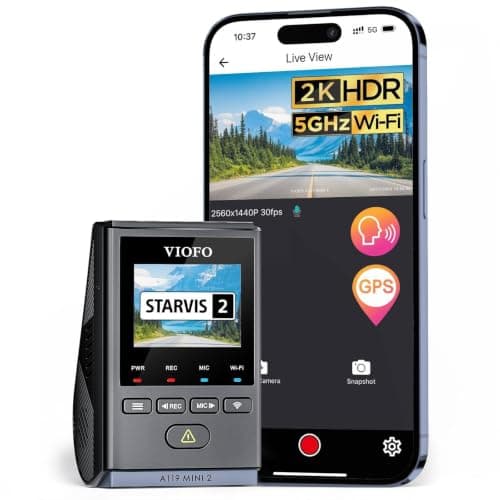 VIOFO A119 Mini 2 Front Dash Cam, STARVIS 2 IMX675, 1440P 60 FPSA named STARVIS 2 IMX675 sensor and a published F1.6 seven-glass lens in a body under three inches tall, for roughly a third less than the two-channel version. It is one channel only — there is no rear camera and no way to add one. | The cheapest camera here that names its Sony sensor | Check price on Amazon #ad We show a price only when we can verify one. How we’re funded |
| 2 | 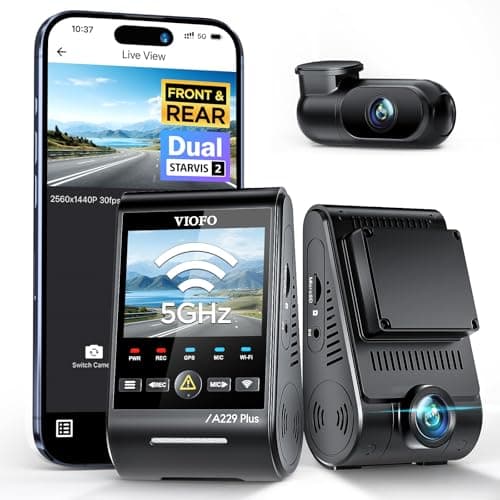 VIOFO A229 Plus 2CH Dash Cam, Dual STARVIS 2 IMX675, 1440P Front and RearThe only camera on this site that names the Sony part number in both channels and publishes what the newer sensor generation is worth — 2.5 times the dynamic range and 2.5 times the light sensitivity of the STARVIS it replaced. You pay for that in resolution: this is a 2K camera at a 4K price. | A sensor you can actually verify, front and rear | $189.99 · View on Amazon #ad Price as of October 25, 2026. How we’re funded |
| 3 | 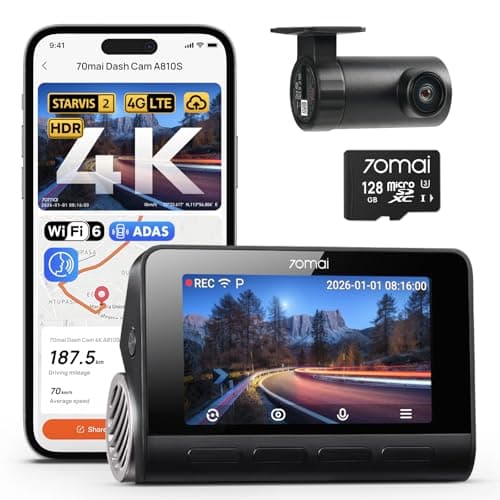 70mai A810 4K Dash Cam, STARVIS 2 IMX678 Front and IMX662 RearThe only camera here that names a different Sony part for each channel — IMX678 front, IMX662 rear — which is the most complete sensor disclosure in this whole comparison. The 4G remote viewing it advertises needs a separate UP05 hardwire kit. | Both sensor part numbers published, front and rear | $169.99 · View on Amazon #ad Price as of October 25, 2026. How we’re funded |
| 4 | 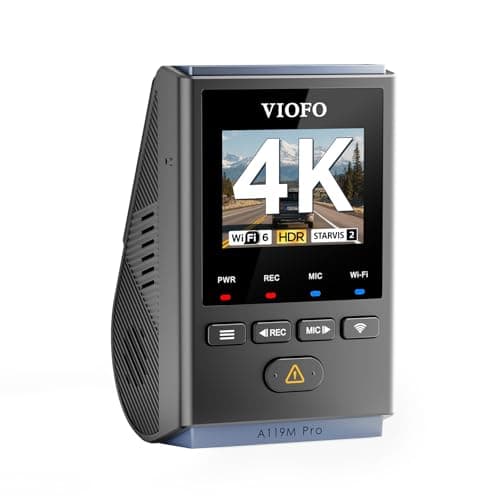 VIOFO A119M Pro 4K Mini Dash Cam, STARVIS 2 IMX678, Wi-Fi 6True 4K on a named STARVIS 2 IMX678, in the same mini body, with the circular polarizing filter included rather than sold as an accessory. It is still a single front channel, and it is the one VIOFO here whose listing contradicts itself on the model field. | 4K with a named sensor, and the CPL filter in the box | $159.99 · View on Amazon #ad Price as of October 25, 2026. How we’re funded |
| 5 | 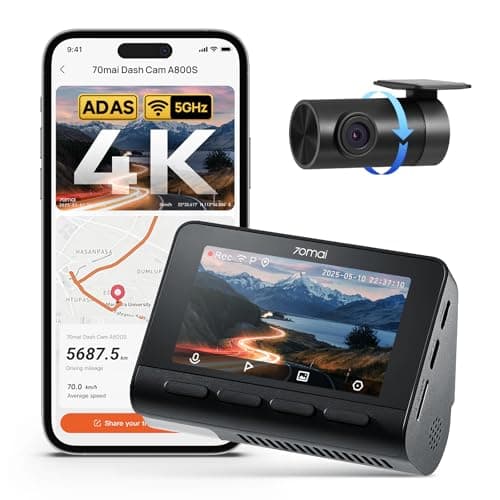 70mai A800S 4K Dash Cam, IMX415 STARVIS, Front and RearSold as a 4K STARVIS camera at the cheapest price in this comparison, and its own feature bullets name the sensor as the IMX415 — a previous-generation STARVIS part, not STARVIS 2. That makes it the most honest demonstration on the site of why the part number matters more than the word. | Showing what the word STARVIS alone is worth | $75.99 · View on Amazon #ad Price as of October 25, 2026. How we’re funded |
#1 · The cheapest camera here that names its Sony sensor
VIOFO A119 Mini 2 Front Dash Cam, STARVIS 2 IMX675, 1440P 60 FPS
VIOFO
A named STARVIS 2 IMX675 sensor and a published F1.6 seven-glass lens in a body under three inches tall, for roughly a third less than the two-channel version. It is one channel only — there is no rear camera and no way to add one.
This is the cheapest route to a verifiable sensor. The IMX675 here is the same part VIOFO puts in both channels of the A229 Plus, so the night-time image quality argument is largely the same argument — you are giving up the rear camera, not the sensor.
The published temperature range is worth as much as the sensor name. 5 F to 149 F is a real, checkable figure, and a camera that lives on a windshield will see both ends of it. Most listings in this category say "temperature proof" and stop.
Size is the other reason to want this one. At 2.93 inches tall it genuinely hides behind a rear-view mirror, which matters if you want the camera to be unobtrusive rather than a second screen in your eyeline.
What works
- Names the Sony part number — STARVIS 2 IMX675
- Publishes a real operating temperature range, 5 F to 149 F
- Publishes the lens: 7-glass, F1.6
- Small enough to hide behind the mirror
- Supercapacitor, built-in GPS, 5 GHz Wi-Fi
- The listing names the exact hardwire kit ASIN instead of leaving you to guess
What does not
- Front channel only — no rear camera and no upgrade path to one
- No memory card included
- Parking mode needs the separate HK4 kit
- HDR costs you half the frame rate
- No interior camera, so it cannot serve rideshare or a monitored driver
Skip this if
Skip it if you want the rear covered. The camera that films the vehicle that rear-ends you is the one this does not have, and no accessory adds it later.
Where these numbers came from
We have not handled this product. Here is what we did instead.
#2 · A sensor you can actually verify, front and rear
VIOFO A229 Plus 2CH Dash Cam, Dual STARVIS 2 IMX675, 1440P Front and Rear
VIOFO
The only camera on this site that names the Sony part number in both channels and publishes what the newer sensor generation is worth — 2.5 times the dynamic range and 2.5 times the light sensitivity of the STARVIS it replaced. You pay for that in resolution: this is a 2K camera at a 4K price.
The number that matters here is not 1440P, it is IMX675. Almost every camera in this price band says "STARVIS" or "STARVIS 2" somewhere in its title and then never names the part, which leaves the claim unverifiable. This listing names it twice and tells you what the generation change bought: 2.5 times the dynamic range and 2.5 times the light sensitivity of the sensor before it. Dynamic range is the specification that decides whether a plate is readable against oncoming headlights.
Then read the HDR note, because it is the honest catch. The 60 FPS front recording and HDR are mutually exclusive — you choose smooth motion or balanced exposure, not both. For evidence, HDR at 30 FPS is almost always the right choice, which means the headline 60 FPS is a specification you will probably turn off.
Two things are not in the box and both cost money: the memory card and the HK4 hardwire kit that all three parking modes require. Budget for both before comparing this with a camera that bundles a card.
What works
- Names the Sony sensor part number — IMX675 — on both channels
- Publishes a quantified generational gain rather than a vague night-vision claim
- Equal resolution front and rear, which is rare; most pair 4K front with 1080P rear
- States the HDR and frame-rate conflict instead of hiding it
- Quad-mode GPS, so the speed and route overlay is dependable
- Supercapacitor rather than a lithium battery
- 18-month warranty, extendable to 24 on registration
What does not
- 2K, not 4K, at a price where 4K cameras exist
- No memory card included at all
- Parking mode needs the HK4 kit as a separate purchase
- Cannot run 60 FPS and HDR together
- No published operating temperature range despite the supercapacitor claim
- No interior channel, so it is the wrong camera for rideshare
Skip this if
Skip it if the number on the box is what you are buying. A 4K front channel costs less elsewhere, and if you will never check whether the sensor is named, you are paying this premium for a specification you do not intend to read.
Where these numbers came from
We have not handled this product. Here is what we did instead.
#3 · Both sensor part numbers published, front and rear
70mai A810 4K Dash Cam, STARVIS 2 IMX678 Front and IMX662 Rear
70mai
The only camera here that names a different Sony part for each channel — IMX678 front, IMX662 rear — which is the most complete sensor disclosure in this whole comparison. The 4G remote viewing it advertises needs a separate UP05 hardwire kit.
Naming a separate sensor part for each channel is the gold standard of disclosure in this category and almost nobody does it. IMX678 front and IMX662 rear tells you precisely where the camera spent its money and where it economized, without you having to infer anything.
The 4G headline needs reading carefully. Remote live view, cloud alerts and location tracking are real features, but they arrive with the optional UP05 kit rather than in the box, and they imply a data plan. Treat the sticker price as the camera only.
Note what is missing: no operating temperature range and no statement of whether a card is included. Both are published by cheaper cameras elsewhere in this comparison.
What works
- Names a Sony part number for each channel separately — the best sensor disclosure here
- True 4K front with a published F1.7 aperture and field of view figures
- 5-mode GPS, the widest constellation support in this group
- Wi-Fi 6
- A genuine 4G remote-viewing path if you want it later
What does not
- 4G remote access needs the UP05 kit as a separate purchase, plus data
- Rear channel is 1080P against a 4K front
- No published operating temperature range
- Does not state whether a memory card is included
- No interior channel
Skip this if
Skip it if you want remote viewing to work out of the box. The 4G features that distinguish this camera are all behind an accessory kit and a data plan, and without them you have paid for a feature set you are not using.
Where these numbers came from
We have not handled this product. Here is what we did instead.
#4 · 4K with a named sensor, and the CPL filter in the box
VIOFO A119M Pro 4K Mini Dash Cam, STARVIS 2 IMX678, Wi-Fi 6
VIOFO
True 4K on a named STARVIS 2 IMX678, in the same mini body, with the circular polarizing filter included rather than sold as an accessory. It is still a single front channel, and it is the one VIOFO here whose listing contradicts itself on the model field.
The IMX678 is a bigger sensor part than the IMX675 and it is what lets this one claim true 4K rather than upscaled 4K. If a readable plate at distance in daylight is the priority, this is the VIOFO to take.
The included CPL filter is a genuine saving and a genuine improvement. A polarizer removes the windshield reflection that otherwise sits across the middle of every daytime clip, and on most cameras it is a twenty-dollar accessory you find out about later.
One caution on the listing itself: the structured model field reads "A119 Mini 2" while the part number and every bullet read A119M Pro. The feature text is specific and internally consistent, so that is the data we have used, but it is the sort of inconsistency worth checking against the product page before you order.
What works
- True 4K with a named sensor part — STARVIS 2 IMX678
- CPL filter in the box, which most cameras do not include
- Wi-Fi 6 with a published 30 MB/s transfer figure
- Publishes an operating temperature range
- Quad-mode GPS and a supercapacitor
- Mini body that hides behind the mirror
What does not
- Front channel only
- No card and no hardwire kit included
- More expensive than the 2K A119 Mini 2 for the same single channel
- The listing's model field says A119 Mini 2, which does not match the part number
- Heavier as listed than the other minis here
Skip this if
Skip it if you want two channels for the money. At this price the A229 Plus gives you a rear camera on the same sensor family, and the rear camera is the one that films the car that hits you.
Where these numbers came from
We have not handled this product. Here is what we did instead.
#5 · Showing what the word STARVIS alone is worth
70mai A800S 4K Dash Cam, IMX415 STARVIS, Front and Rear
70mai
Sold as a 4K STARVIS camera at the cheapest price in this comparison, and its own feature bullets name the sensor as the IMX415 — a previous-generation STARVIS part, not STARVIS 2. That makes it the most honest demonstration on the site of why the part number matters more than the word.
Read the title and the bullets against each other. The title sells STARVIS. The bullets name the IMX415. Both statements are true and they are not the same claim: the IMX415 belongs to the generation that STARVIS 2 parts are compared with, and VIOFO publishes that gap as 2.5 times the dynamic range and 2.5 times the light sensitivity.
That does not make this a bad camera. It makes it a correctly priced one — it is the cheapest unit in this comparison and it names its part, which is more than several more expensive cameras manage.
The flip-round rear camera is a real feature worth knowing about: it can face backwards or into the cabin, which is an unusual amount of flexibility at this price, though you only get one of the two at a time.
What works
- Names its sensor part number, which many pricier cameras do not
- Cheapest camera in this comparison by a wide margin
- Rear camera flips to film either behind you or inside the car
- Publishes the lens: 7-glass, F1.8
- ADAS, built-in GPS, dual-band Wi-Fi with OTA updates
- Names the exact hardwire kit ASIN for parking mode
What does not
- Sold as STARVIS but the part is a previous-generation IMX415, not STARVIS 2
- Title and bullets sell the same sensor two different ways
- No card included and a 256 GB ceiling, the lowest here
- Parking mode needs the UP03 kit
- No published operating temperature range
Skip this if
Skip it if night-time plate legibility is the specific reason you are buying a camera. That is the job the newer sensor generation exists to do, and the maker of those sensors' customers publish a figure for the difference.
Where these numbers came from
We have not handled this product. Here is what we did instead.
| Spec | VIOFO | VIOFO | 70mai | VIOFO | 70mai |
|---|---|---|---|---|---|
| Channels | 1 — front only; no rear camera support | 2 — front and rear | 2 — front and rear | 1 — front only | 2 — front and rear (rear camera flips to film the cabin) |
| Resolution | 1440P at 60 FPS, or up to 2592x1944P at 30 FPS | 1440P front + 1440P rear; front up to 60 FPS | 4K front + 1080P rear | 4K at 30 FPS | 4K front + 1080P rear |
| Sensor | Sony STARVIS 2 IMX675 | Two Sony STARVIS 2 IMX675 | Sony STARVIS 2 IMX678 front, IMX662 rear | Sony STARVIS 2 IMX678 | Sony IMX415 |
| Lens | 7-glass, F1.6 aperture, 140 degrees | Not published | Not published | Not published | 7-glass, F1.8 aperture |
| HDR trade-off | With HDR enabled the frame rate drops from 60 to 30 FPS | Front 1440P 60 FPS is unavailable while HDR is enabled | Not published | Not published | Not published |
| GPS | Built-in — route, speed and time written into the file | Quad-mode — GPS, BEIDOU, GALILEO, GLONASS | 5-mode — GPS, BDS, GALILEO, GLONASS, QZSS | Quad-mode — GPS, BeiDou, Galileo, GLONASS | Built-in |
| Wi-Fi | 5 GHz | 5 GHz | Wi-Fi 6 | Wi-Fi 6, stated at up to 30 MB/s transfer | Dual-band 5 GHz / 2.4 GHz, with over-the-air firmware updates |
| Power storage | Supercapacitor | Supercapacitor | Not published | Supercapacitor | Not published |
| Operating temperature range | 5 F to 149 F | Not published | Not published | 5 F to 149 F | Not published |
| Parking modes | 3 — buffered auto event detection (15s before / 30s after), low bitrate, time-lapse | 3 — auto event detection buffered 15s before / 30s after, time-lapse, low bitrate | Not published | 3 — auto event detection buffered 15s before / 30s after, low bitrate, time-lapse | Not published |
| Hardwire kit | HK4, sold separately (the listing names ASIN B09MRVP2PX) | HK4, sold separately — parking mode does not work without it | Not published | HK6, not included | Not published |
| Card included | None. Class 10 or UHS-I required, up to 512 GB | None. 128 / 256 / 512 GB supported | Not published | None. 64 / 128 / 256 / 512 GB supported | Not published |
| Dimensions | 2.93 x 1.81 x 1.63 in | 3.86 x 2.36 x 1.77 in | 2.13 x 1.17 x 1.00 in | 2.94 x 1.86 x 1.81 in; 1.04 lb as listed | 2.13 x 1.10 x 1.00 in |
| Warranty | 18 months, plus 6 months on registration | 18 months, plus 6 months on registration | 18 months | 18 months, plus 6 months on registration | 18 months |
| Published sensor gain | Not published | 2.5x dynamic range, 2.5x light sensitivity vs STARVIS | Not published | Not published | Not published |
| Voice control | Not published | 12 commands | Not published | Not published | Not published |
| Lens aperture | Not published | Not published | F1.7 | Not published | Not published |
| Field of view | Not published | Not published | 146 degrees front, 130 degrees rear | Not published | Not published |
| 4G remote viewing | Not published | Not published | Optional, requires the UP05 4G hardwire kit, not included | Not published | Not published |
| Parking mode | Not published | Not published | 24-hour with time-lapse; requires a hardwire kit | Not published | 24-hour G-sensor triggered; requires the UP03 hardwire kit (listing names ASIN B09TDZ6FWZ), not included |
| Driver assistance | Not published | Not published | ADAS — lane departure and forward collision warnings | Not published | ADAS — lane departure and forward collision warnings |
| CPL filter | Not published | Not published | Not published | Included as standard | Not published |
| Card support | Not published | Not published | Not published | Not published | 32 to 256 GB, U3 or higher, not included |
When the sensor is not the thing to fix
If your current camera produces unreadable night footage, the sensor is one of four candidates and often not the first one worth money:
- The windshield. A reflection of your own dashboard sitting across the middle of the frame is a polarizing filter problem, not a sensor problem. The VIOFO A119M Pro includes a CPL filter; on most cameras it is an accessory, and it is the cheapest real improvement available.
- The glass in front of the lens. The inside of a windshield films over with a haze that no sensor sees through. Clean it properly before concluding anything about the camera.
- The card. A camera dropping frames because the card cannot sustain the write rate produces footage that looks like a bad sensor and is not. The memory card page on this site covers what to look for.
- The exposure setting. Many cameras ship with HDR off and a frame rate set high. On the VIOFO models here, HDR and the top frame rate are mutually exclusive — and for evidence, HDR at the lower frame rate is almost always the right choice.
What we cannot tell you
We have not photographed a plate at night with any of these cameras, and we are not going to imply that we have. Everything above is read from published specification, and there are three things specification cannot settle.
It cannot tell you how a particular camera's processing uses the sensor it has — two cameras on the same part can produce visibly different footage. It cannot tell you whether a listing that names a part number is accurate, only that it has made a checkable claim rather than an unfalsifiable one. And it cannot rank these on image quality, which is why this page ranks them on what they are willing to publish instead.
Sources
Everything on this page traces back to one of these. Where a figure could not be sourced, the page says so rather than filling the gap.
- Sony Semiconductor Solutions, STARVIS and STARVIS 2 back-illuminated CMOS image sensor technology for security camera applications — the maker's own description of the sensor family
- VIOFO A229 Plus, two Sony STARVIS 2 IMX675 sensors stated at 2.5x dynamic range and 2.5x light sensitivity versus STARVIS, 1440P+1440P, front 60fps unavailable with HDR enabled — retailer listing, Amazon.com (retrieved 2026-10-17)
- VIOFO A119 Mini 2, STARVIS 2 IMX675, 7-glass F1.6 lens, supercapacitor rated 5F to 149F — retailer listing, Amazon.com (retrieved 2026-10-17)
- VIOFO A119M Pro, STARVIS 2 IMX678, true 4K 30fps, CPL filter included, Wi-Fi 6 — retailer listing, Amazon.com (retrieved 2026-10-17)
- 70mai A810, dual Sony STARVIS 2 named as IMX678 front and IMX662 rear, F1.7 aperture, 146 and 130 degree fields of view — retailer listing, Amazon.com (retrieved 2026-10-17)
- 70mai A800S, title states STARVIS while the feature bullets name the sensor as Sony IMX415, 7-glass F1.8 lens — retailer listing, Amazon.com (retrieved 2026-10-17)
- Baseus VD1 Pro Solar, IMX335 sensor described as STARVIS, 6-layer glass f/1.6 — retailer listing, Amazon.com (retrieved 2026-10-17)
- COOAU D30S, bullets state a Sony STARVIS 2 chip with no part number, F1.8 aperture, tested -4F to 158F — retailer listing, Amazon.com (retrieved 2026-10-17)
- REDTIGER F7NP, title and bullets state a STARVIS 2 sensor with no part number published, F1.5 aperture, 6-layer lens — retailer listing, Amazon.com (retrieved 2026-10-17)
- VIOFO A229 Pro, title states 4K HDR and dual STARVIS 2; the listing publishes no feature bullets, no part number, no rear resolution and no warranty term — retailer listing, Amazon.com (retrieved 2026-10-17)